

Partners, Not Rivals: HKUST Grads Demonstrate Why the AI Workplace Revolution Makes Us More Human
As a landmark study reveals Hong Kong’s world-leading AI adoption rate, three HKUST alumni show how integrating technology enables professionals to focus on uniquely human strengths.
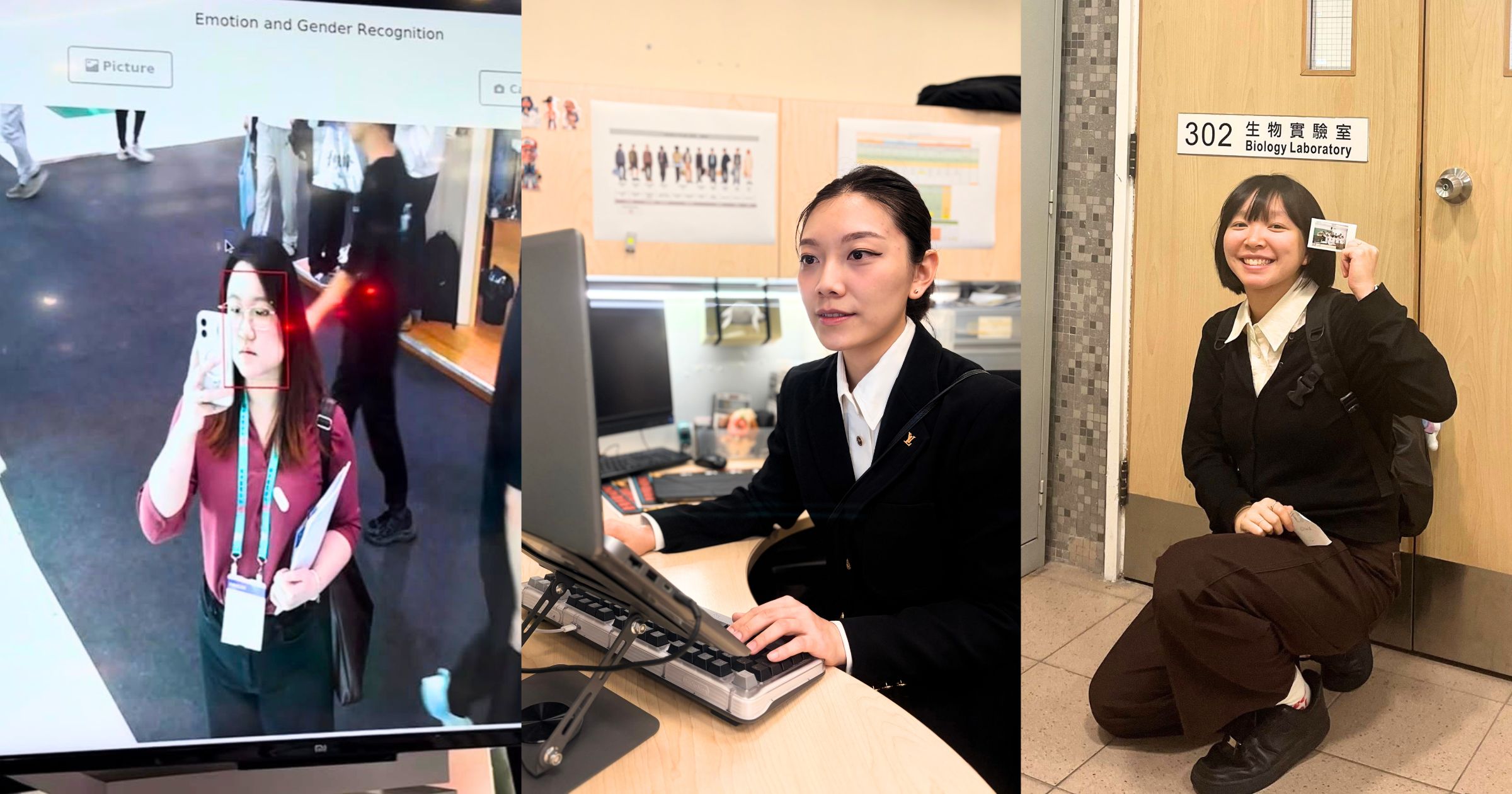
At Deutsche Telekom, Niki HO, a 2023 BEng in Decision Analytics graduate, has a desk that looks like any other corporate workspace. One difference is how fast her screen works. A comprehensive market intelligence report that once demanded three weeks of grueling data gathering can now be completed in a third of the time.
Rather than feeling threatened, Niki watches the algorithm assemble the heavy analytics, knowing her real work is just beginning.
Not so far away, at Louis Vuitton’s Canton Road flagship, Team Manager Agnes LAM, a 2023 BBA in Global Business graduate, steps away from her laptop to greet a client. In the back office, her team uses MalA, the luxury group’s proprietary AI assistant, to translate product specs and compile client materials in seconds. By delegating the administrative tasks, she shifts her energy entirely to building authentic, personalized customer relationships.
Meanwhile, in a secondary school biology class, trainee teacher Audrey CHAN, a 2025 BSc in Biotechnology graduate, reviews an AI-generated lesson outline before stepping in front of her students. She has learned to use these tools as tireless co-designers. Yet, she observes that while AI can easily map out a syllabus, it falters at recognizing a student’s confusion, inspiring a struggling learner, and verifying the errors that slip into automated homework.
Though their days unfold in entirely different spheres, these three HKUST alums mirror a rapidly shifting professional landscape. Their daily routines offer a quiet preview of the future of work, raising a profound question: as machines grow smarter, what uniquely human role is left for us to play?
The Hope and Hesitation
The answer lies in the data, which reveals a workforce enthusiastically embracing the future of work, yet quietly wrestling with fear of being left behind.
A recent study titled “AI in the Workplace: Perceptions and Preparedness of Workers,” conducted by the HKUST Business School, collected 3,722 responses across diverse industries. It stands as one of the largest studies of workplace AI in Hong Kong in recent years, capturing a vivid picture of a workforce in flux.
The findings show that Hong Kong leads the world in workplace AI adoption, with an astonishing 72.7% of local professionals using AI tools weekly or even daily, significantly outpacing the 31% global average. Among these active users, generative tools dominate, with 81.66% relying on them to draft documents, analyze data, and fuel creative brainstorming.
The swift adoption, however, brings a complex reality. Although nearly 80% of workers credit these tools with driving efficiency and productivity, 40% of junior employees feel their job security is compromised. In comparison, nearly 60% have never received any formal training to bridge this widening capability gap.
"What is particularly noteworthy is that workers hold both optimism and concern toward AI,” says Prof. TAM Kar-Yan, HKUST Vice-President for Administration and Business, who led the study.
“On the one hand, they recognize its potential to enhance productivity, improve work quality, and create opportunities. On the other hand, many are concerned about the risk of skills becoming outdated and the implications for job security," he explains.
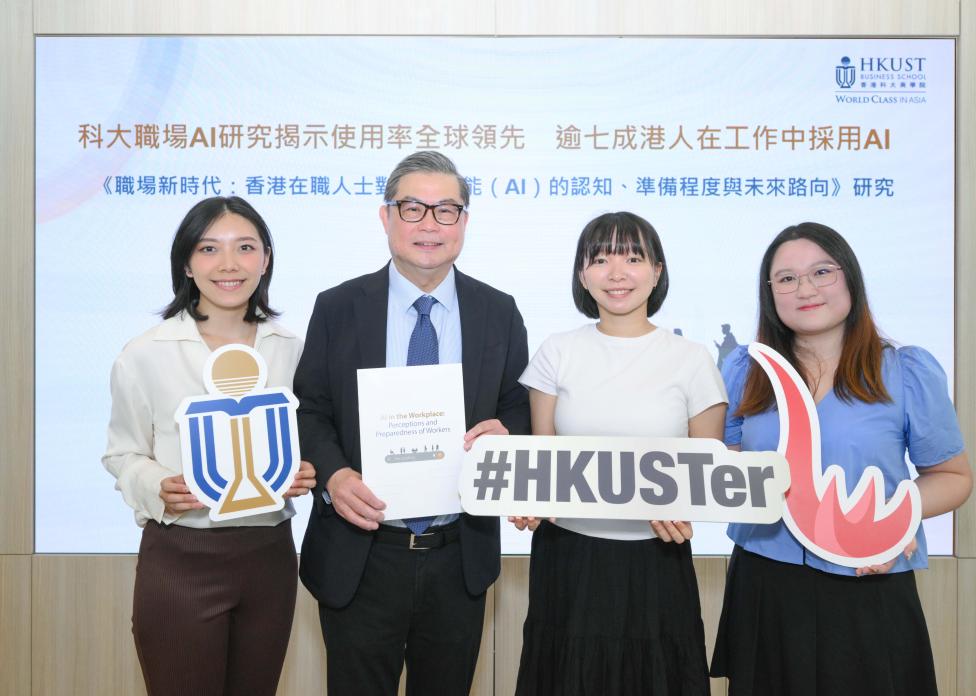
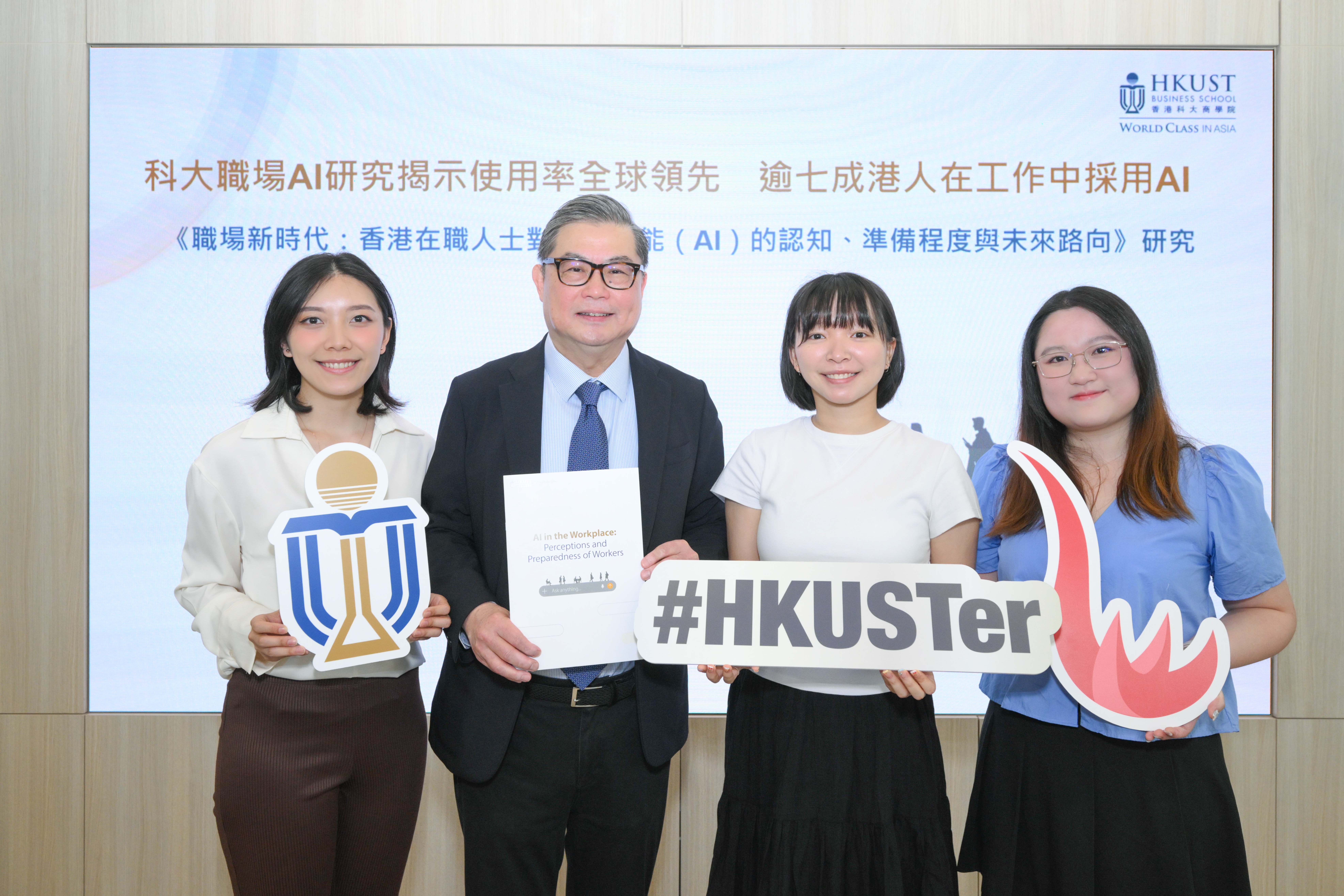
A recent survey conducted by HKUST revealed that over 70% of Hong Kong’s working professionals frequently use AI tools in their jobs, a rate significantly higher than the global average.
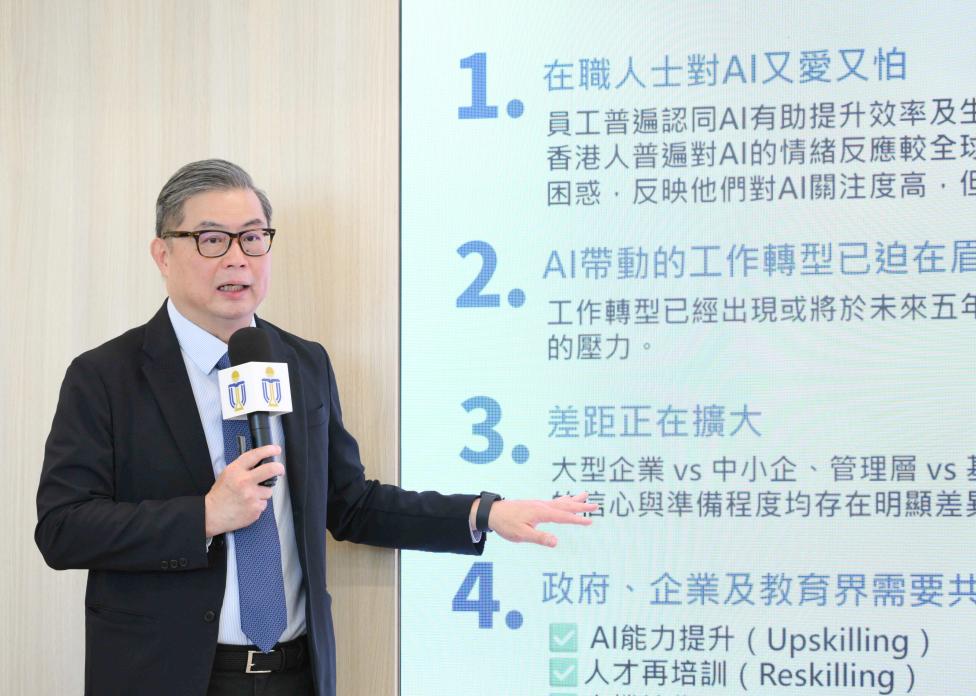
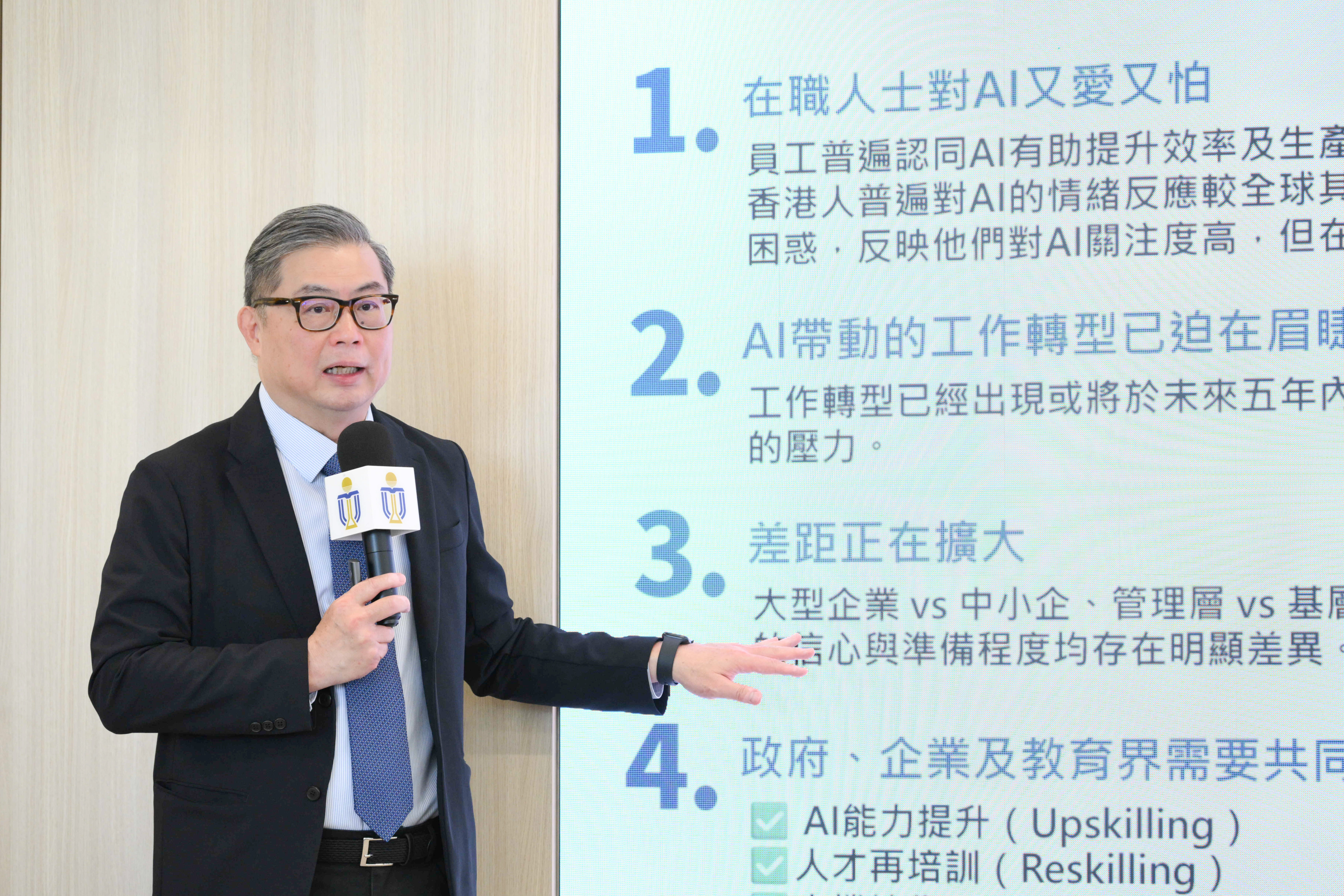
Prof. Tam Kar-Yan said nearly 60% of respondents believe AI-driven workplace transformation has already begun or will take place within the next five years.
Elevating the Human Element
Faced with this growing anxiety, the three HKUST graduates have discovered that the rise of AI actually clarifies the true value of their human roles.
For Niki, mastering AI tools meant letting go of the fear of being replaced. "Taking over the tedious data gathering frees me to focus on high-level business strategy, professional judgment, and deep client engagement," she reflects. Essentially, she has transitioned from a data processor into a strategic decision-maker.
At Louis Vuitton, Agnes has observed a similar truth. "Luxury is built on relationships and detail," she explains. For her team, MaIA does not stand between the brand and the customer. Instead, it handles the mechanical tasks, leaving advisors free to deliver a genuinely premium, high-touch customer experience.
This shift from transactional tasks to meaningful human interaction is echoed in the classroom, where the stakes are even higher. In an AI-saturated world, teacher-to-be Audrey sees her primary role as helping students think critically and evaluate sources responsibly.
This kind of deep human connection, mentorship, and moral guidance offers elements that no chatbot can replicate, especially when confronted by AI-driven schoolwork.
“I have seen students try to turn in homework generated entirely by AI, often containing factual errors,” she says.
Bridging the Capability Gap
As the first university in Hong Kong to deploy a campus-wide generative AI platform, HKUST has proactively integrated these tools into its teaching models.
Beginning this September, the University is doubling down on a renewed focus in curriculum design: Human-AI Co-Creation and Data Literacy. Through the "Major + X" extended major framework—which combines a student's major with an emerging, cross-disciplinary subject—students from all disciplines learn to blend traditional academic expertise with hands-on AI applications. The goal is to cultivate interdisciplinary thinkers who can translate advanced technology into tangible social and commercial value.
This forward-thinking program design directly supports the city's broader digital transformation goals. As outlined in the Chief Executive's 2025 Policy Address, Hong Kong is enthusiastically advancing its "AI+" agenda, accelerating industrialization, and integrating smart tools across diverse sectors. Building an AI-ready talent pipeline is critical to securing the city's long-term competitive edge.
"Successfully advancing Hong Kong's 'AI+' agenda will depend not only on accelerating technology adoption, but also on ensuring that no segment of the workforce is left behind," Prof. Tam emphasizes. "Bridging AI capability gaps and equipping workers with practical AI skills will be essential to building a more innovative, inclusive, and competitive economy."
A New Horizon of Human Potential
This shift may feel like uncharted territory, but humanity has stood at similar crossroads before. The steam engines of the Industrial Revolution once sparked riots over displaced craftsmanship, only to eventually liberate workers from back-breaking physical toil. Centuries later, the sudden rise of the personal computer and the internet triggered parallel warnings of administrative obsolescence. In reality, new technologies democratized information and created entirely new industries.
These historical upheavals remind us that while dramatic technological advances can disrupt, they ultimately elevate, rather than erase, human potential.
Of course, generative AI introduces a deeper shift because it operates in the cognitive domain, making its vast speed feel uniquely challenging to our professional identity. But by delegating the repetitive and mechanical to algorithms, Niki, Agnes, and Audrey show how we can reclaim the space to do what we do best: guide business growth, foster customer trust, and inspire young minds.
The future belongs not to the machines, but to those who learn how to steer them.