




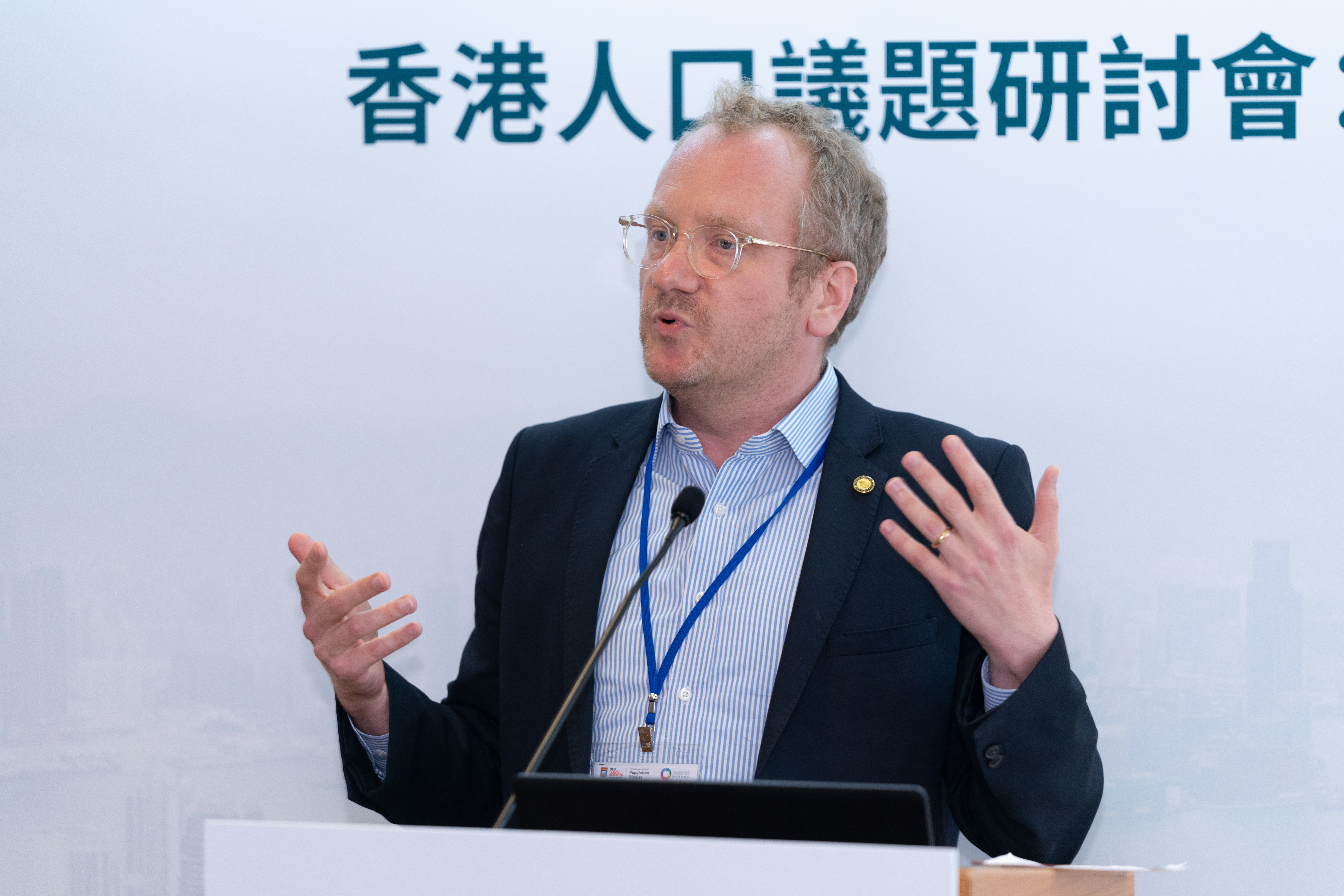
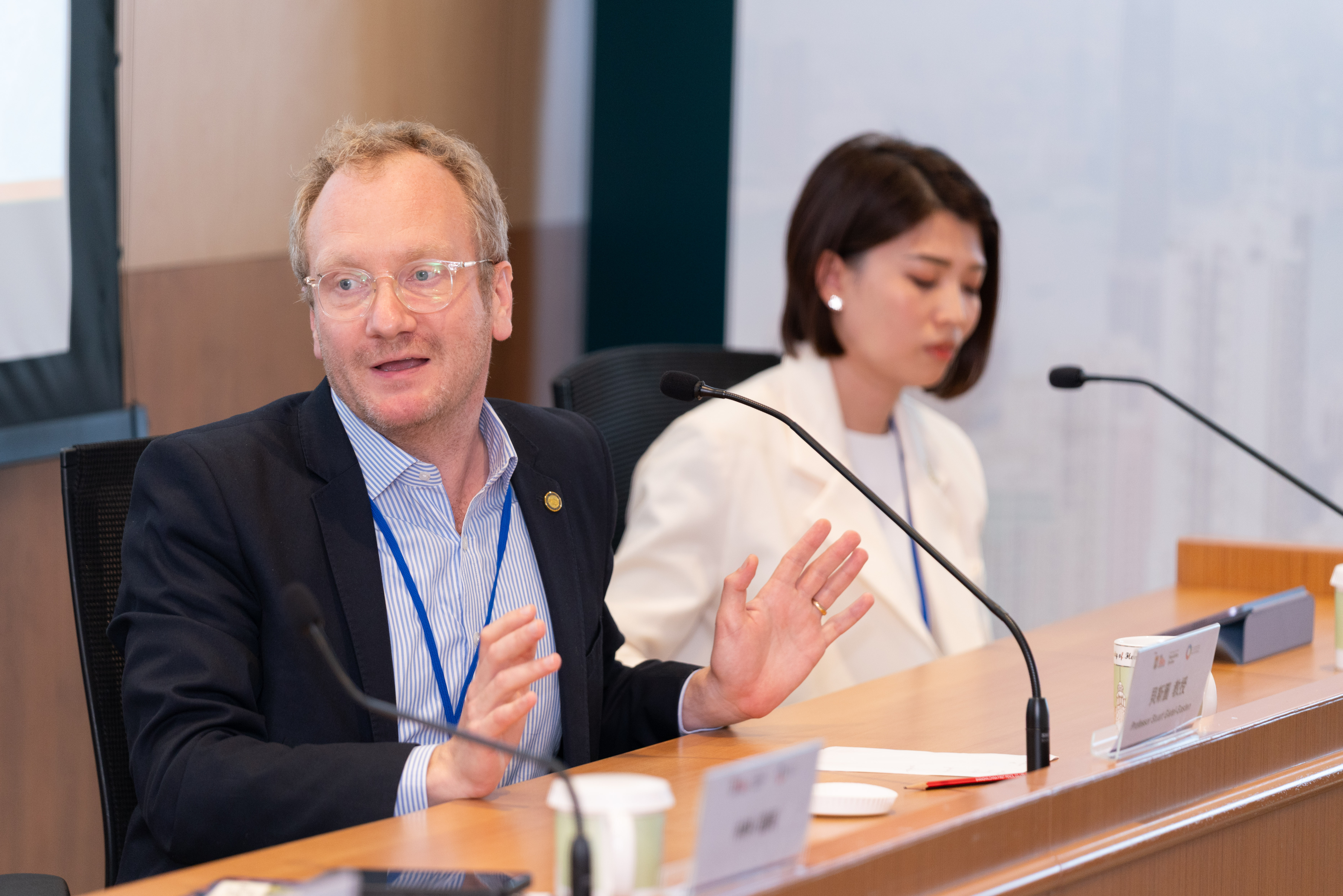
Prof. Stuart Gietel-Basten, Associate Dean for Research, Global Engagement, and Equity, Diversity, and Inclusion (EDI) at HKUST's School of Humanities and Social Science, has been appointed to the G7 Gender Equality Advisory Council in recognition of his leadership and scholarly work in social science and public policy.
The Council is an independent advisory body that provides recommendations on gender equality to G7 leaders.
Boundless: What is your role in the G7 High-Level Advisory Council on Gender Equality?
Prof. Gietel-Basten: The Gender Equality Advisory Council (GEAC) has been a fixture of the G7 since Canada's presidency in 2018. Each year, the country holding the presidency convenes a group of around twenty independent experts to develop policy recommendations on gender equality.
The 2026 Council, under the French Presidency of the G7, has a specific mandate: to look at demographic change — and the conditions for what President Macron's team has described as "chosen and fulfilling parenthood" — through an explicitly feminist and gender-responsive lens.
My role, alongside the other members, is to bring research-based evidence to bear on the design of family and population policy, and to help develop concrete recommendations that can inform the work of G7 governments and beyond.
Boundless: How were you selected?
Prof. Gietel-Basten: The nomination drew on my research on the role of gender in demographic change — particularly low fertility, the unequal distribution of care within households, and the motherhood penalty in the workplace and the wider public sphere — as well as my work on the specific needs of older women in rapidly ageing societies.
The recommendation, which drew on my work with the United Nations Population Fund (UNFPA), was then taken up by President Macron's team, who issued the formal invitation.
Boundless: What is your role in gender equality at HKUST?
Prof. Gietel-Basten: I am Associate Dean in the School of Humanities and Social Science with responsibility for research, global engagement, and equity, diversity, and inclusion. I am genuinely proud that our School's leadership has chosen to develop a dedicated EDI portfolio at a time when many parts of the world are pulling back from this work — it sends an important signal.
Within HKUST, I have advocated for improved and extended care-related leave policies viewed through a gendered lens and helped organise community-building events around these issues, including our recent International Women's Day alumni gathering.
I am also part of the first cohort of the Male Allies programme, which HKUST has engaged with The Women's Foundation. HKUST is the first university in Hong Kong to take part, which makes our cohort the first male allies of any Hong Kong university.
Boundless: Please can you elaborate on your experience and expertise in this area?
Prof. Gietel-Basten: My research has consistently emphasised gender as a root cause — not merely a correlate — of the gap between people's fertility aspirations and what they are able to achieve, and of related questions around work–life balance and relationship quality.
On the empirical side, I serve as the Asia coordinator for the Generations and Gender Survey (GGS), the world's pre-eminent comparative longitudinal study of gender roles, family formation, work, intergenerational care, and reproductive health.
With strong institutional support, our team ran the first wave of the GGS in Hong Kong — the first fully comparative survey of its kind here, with gender at its centre — and I have worked with collaborators on parallel surveys in South Korea and Taiwan.
On the policy side, I have worked for several years with UNFPA, the Asian Development Bank, HelpAge International, and China's National Development and Reform Commission to promote gender mainstreaming in population policy.
These projects insist that gender is taken seriously across all dimensions of demographic change — fertility, marriage, ageing, and access to health and social welfare. I have reviewed and helped develop population and family policies in Lao PDR, mainland China, Thailand, Vietnam, Cambodia, and Bhutan.
Methodologically, my collaborators and I have shown empirically — in settings as different as China, Thailand, and Iran — that investing in women's empowerment, particularly through female labour force participation built on sustained improvements in girls' education, is a more effective and more sustainable route to economic and demographic resilience than any pronatalist agenda.
This work has been published in journals including PNAS and the BMJ, and the broader research-to-policy pipeline formed the basis of one of HKUST's impact case studies in the 2026 Research Assessment Exercise.
Boundless: What does your involvement with the G7 High-Level Advisory Council on Gender Equality mean to you personally and as a HKUST faculty member?
Prof. Gietel-Basten: It means a great deal. First, it is an opportunity to translate our research in Hong Kong, across Asia, and in many other parts of the world into policies that can make a tangible difference in people's lives.
That feels especially urgent now: there is real fear and panic in many capitals about low fertility, and the instinctive response is too often to reach for simplistic answers (i.e. just push for more babies) — and, in the worst cases, to push policies that actively roll back hard-won gains in gender equality and in sexual and reproductive health and rights.
To play a small part in building a robust, feminist, progressive evidence base for gender-responsive family policy is a real honour.
It is also an honour to do this alongside the French government as G7 president. HKUST has long-standing and close ties with France, including through the French Centre for Research on Contemporary China (CEFC), which has been a strong research partner within our School.
I should also say that this opportunity rests on years of institutional support at HKUST. The decision to back the Generations and Gender Survey in Hong Kong — championed by former School of Humanities and Social Science Dean Kellee Tsai and former Acting Provost TC Pong — has been transformative, and the survey is now feeding directly into local population policy through our engagement with stakeholders and Legislative Council members. The Institute for Emerging Market Studies has been an invaluable partner in turning our findings into policy briefs that reach a wider audience.
Boundless: Do you have any specific comments you would like to share with the HKUST community about gender equality?
Prof. Gietel-Basten: This may sound strange, but I sometimes notice a slightly quizzical reaction when I — a white, English, heterosexual, cisgender man — am recognised for arguing strongly for gender equity and for the rights of sexual and gender minorities. I'd like to push back on that gently.
When any of us look honestly at the world around us and see that other people are not given the same opportunities we ourselves have been given — for no reason other than some characteristic of who they are — we have a deep responsibility to act. That responsibility has two parts. The first is to try to understand, scientifically and rigorously, why the opportunity gap exists. The second is to do everything in our power to work together to close it. That responsibility belongs to all of us, not only to those who carry the burden of inequality themselves.
Boundless: Many thanks for sharing your thoughts with us, and best of luck with your work with the G7 Gender Equality Advisory Council.
For more about SDG 5: Gender Equality at HKUST, please visit here and here for more about Diversity and Equal Opportunities at HKUST.