







Beyond Borders: The Hidden Ripple Effect of Urban Emission Reduction
A landmark HKUST study reveals why cities can no longer solve the climate crisis in isolation.
When a city pledges to go green, it is tempting to imagine building an invisible environmental wall around its borders. But the atmosphere does not read metropolitan maps. As a team of HKUST researchers has shown through recent research, the most pressing climate challenge of our time lies in the complex web of emissions that inextricably links local sustainability to the actions of urban centers around the world.
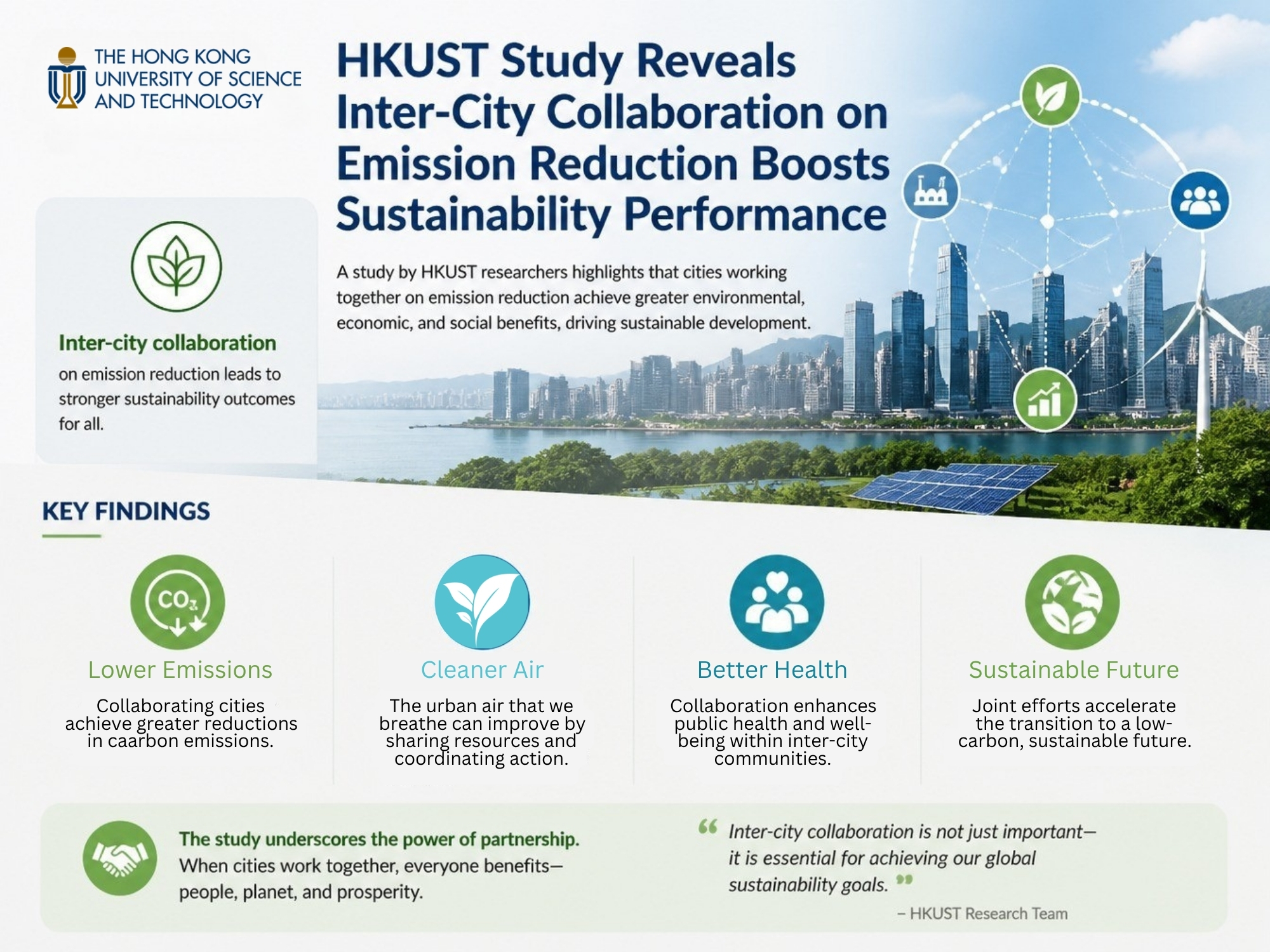
This paradigm shift is the focus of a landmark international study led by Prof. LU Mengqian of HKUST’s Department of Civil and Environmental Engineering. Published in Nature Communications, the research reveals that inter-city collaboration on emission reduction can boost overall sustainability performance by more than 10%. To map this intricate network, Prof. Lu and her team analyzed 11 years of satellite data from 4,116 cities across 103 countries, representing over 90% of global GDP between 2010 and 2020.
Conventional environmental governance typically treats emission reduction as a purely local issue, Prof. Lu notes. The data, however, tells a different story, one of profound interdependence. The study found that 93.5% of cities are measurably influenced by the emission performance of others. When neighboring cities improve air quality and lower carbon emissions by 10%, a focal city experiences a corresponding sustainability gain of up to 0.45% across key UN Sustainable Development Goals (SDGs).
This creates a "ripple effect" that can be either beneficial or involve trade-offs. Hong Kong, for instance, recorded synergistic gains in reduced CO2 emissions in 2020, largely driven by industrial upgrading in neighboring Greater Bay Area cities. Copenhagen similarly benefited from cross-border climate cooperation.
In contrast, Beijing experienced a trade-off effect involving particulate matter (PM2.5 and PM10), illustrating how pollution-intensive activities can sometimes shift to neighboring regions rather than be eliminated.
Encouragingly, the study found that positive connections outnumber negative trade-offs by 2:1. Simulations further demonstrated that deep inter-city cooperation can improve overall SDG performance by nearly 11% compared with cities acting independently. The research also highlights a fascinating temporal trend: the overall intensity of these cross-city influences is gradually declining.
This suggests that as cities strengthen their green policies and industrial foundations, local environments become more resilient to external emissions shocks.
"Emission governance is no longer a purely local affair, but a global issue requiring cross-regional, inter-city coordinated advancement. We hope these findings will empower governments and international organizations to formulate more coordinated and evidence-based strategies for emission reduction and sustainable urban development," says Prof. Lu.
The study itself reflects this spirit of collaboration, bringing together researchers from HKUST, HKU, HKBU, PolyU, and international partners across the US, South Korea, and Australia. As the climate crisis deepens, HKUST's message is clear: securing a sustainable local future requires looking beyond city borders.
The key takeaway is that a city’s environmental sustainability is inextricably linked to its neighbors' actions.