





Prof. HSING I-Ming on the World's First DNA-Guided CRISPR-Cas System
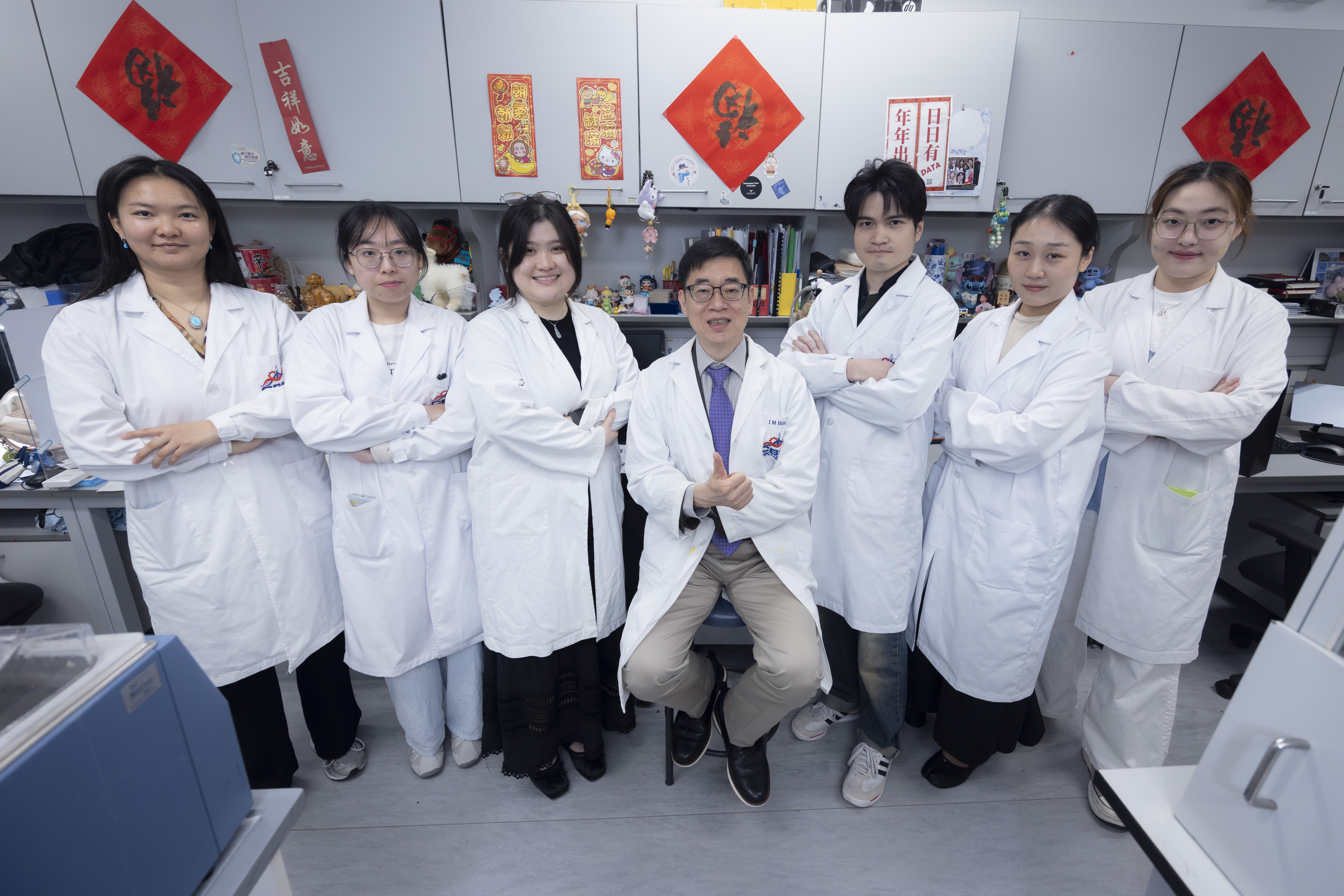
Boundless: Professor Hsing, thank you for joining us. Could you start by telling us about the breakthrough your team has recently published in Nature Biotechnology?
Prof. Hsing: Certainly. Our team at HKUST's Department of Chemical and Biological Engineering, in collaboration with Prof. ZHAI Yuanliang from the Division of Life Science, has developed the world's first DNA-guided CRISPR-Cas system that is capable of programmable RNA targeting and cleavage.
This new system upends the conventional CRISPR paradigm, which uses RNA as a guide to target DNA. It opens entirely new avenues for RNA-targeted therapies and diagnostics.
Boundless: What exactly is CRISPR?
Prof. Hsing: It is short for “clustered regularly interspaced short palindromic repeats,” and refers to technology that scientists use to modify the DNA of living organisms selectively.
Boundless: This DNA-guided CRISPR-Cas system sounds groundbreaking. Could you explain how it works?
Prof. Hsing: Think of the CRISPR-Cas system like a GPS navigation system. The guide molecule is like the address you type in, and the Cas protein is the car that drives to that address—the target. In traditional systems like SHERLOCK and DETECTR, RNA serves as the address to find the DNA. But we've inverted this system. By engineering a synthetic “CRISPR DNA,” or crDNA molecule, we can reprogram the Cas12a protein to use DNA as the guide, thereby targeting specific RNA molecules. Building on this mechanism, we developed a new diagnostic platform called SLEUTH, short for Specific Locus Evaluation Utilizing Targeted Hydrolysis. We are also extending this technology to applications for cellular RNA manipulation.
Boundless: What was the key scientific insight that made this possible?
Prof. Hsing: The breakthrough lies in decoupling two functions that are normally combined in natural CRISPR systems: the "activation" signal (the PAM sequence) and the "information-carrying" address. By designing a short DNA strand that mimics the PAM-containing duplex, we have created a functional protein complex capable of recognizing and cleaving to any selected RNA target.
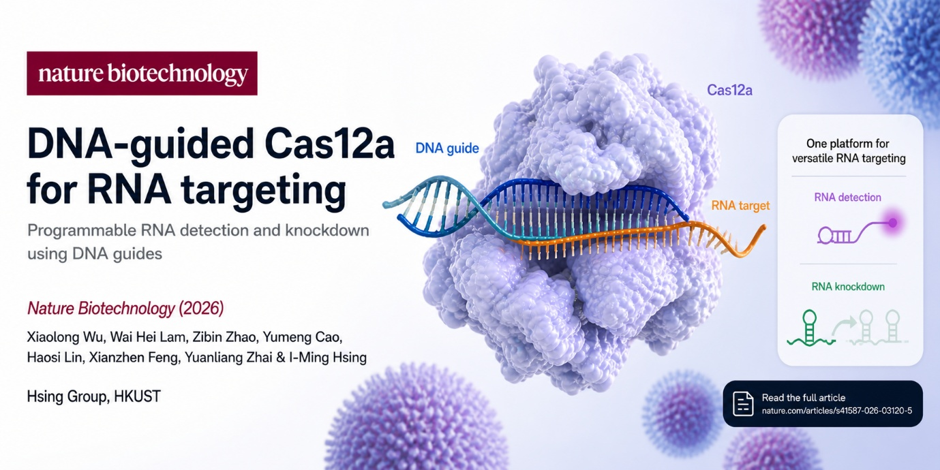
Boundless: Can you tell us more about this image?
Prof. Hsing: The banner illustrates our newly developed DNA-guided Cas12a platform for RNA targeting. In the center, the large purple structure represents the Cas12a protein, while the blue DNA strand acts as a programmable DNA guide that directs Cas12a to recognize a specific orange RNA target. Unlike conventional CRISPR systems that typically rely on RNA guides, our technology uses DNA guides to program Cas12a for RNA recognition, enabling versatile RNA detection and knockdown within a single platform. The right panel highlights these two major applications: sensitive RNA sensing and programmable RNA regulation.
Boundless: You mentioned a collaboration with Prof. Zhai. How did that partnership contribute to this study?
Prof. Hsing: It was essential. Prof. Zhai’s expertise in structural biology has been critical to verifying our engineered system at the molecular level. As he has noted, observing the synthetic DNA guide interacting with Cas12a at atomic detail clearly demonstrates how AI-driven design and structural biology can work together synergistically.
Boundless: What practical advantages does a DNA-guided system offer over existing RNA-based approaches?
Prof. Hsing: Several significant ones. First, our DNA-guided system is more stable. For example, synthetic DNA is more chemically stable than RNA. Unlike RNA, DNA remains stable at ambient temperatures, greatly simplifying logistics.
Second, lower costs. DNA synthesis is significantly cheaper than RNA synthesis, which requires additional chemical protection steps and cold-chain handling.
Third, greater precision: Our system can discriminate single-nucleotide differences in the target RNA, a level of accuracy that RNA interference, or RNAi, tools typically cannot achieve.
Fourth, wider applicability: Whereas conventional RNAi approaches are used primarily for mRNA silencing, our system can, in principle, be extended to a wider spectrum of RNA targets, including non-coding RNAs such as microRNAs and long non-coding RNAs, which play central roles in gene regulation and disease.
Fifth, safer for therapy: Compared to existing RNA-targeting CRISPR tools like Cas13, our Cas12a-based system shows significantly less off-target RNA cleavage in cells—meaning fewer collateral effects—a critical safety consideration for therapeutic development.
Boundless: How might this technology impact public health, especially in our region?
Prof. Hsing: Hong Kong and the broader region have been repeatedly affected by viral pathogens such as SARS, influenza, and COVID-19. Many of these viruses carry RNA genomes or rely on RNA intermediates to replicate. A DNA-guided CRISPR tool capable of precisely cleaving those RNA molecules could form the basis of a new class of antiviral intervention.
Boundless: What are the next steps for this technology?
Prof. Hsing: HKUST has filed two U.S. provisional patents for this innovation. We're actively exploring applications in RNA diagnostic testing, antiviral therapies, live-cell RNA imaging, and programmable regulation of RNA transcripts. Over the next three years, we plan to expand the SLEUTH platform to detect other respiratory viruses and explore its potential in liquid biopsy applications to identify circulating RNA biomarkers in cancer. In parallel, my PhD student and lead co-first author, WU Xiaolong, is working to extend this technology into antiviral applications and RNA imaging. This work aligns closely with HKUST's newly established School of Medicine and the University's growing emphasis on translational medicine and RNA-based therapies.
Boundless: Finally, what message would you like to share with the scientific community and the public?
Prof. Hsing: This work demonstrates that by rethinking fundamental biological paradigms—like inverting the guide-target relationship in CRISPR—we can unlock entirely new design spaces for programmable molecular tools. The convergence of engineering, AI-driven modeling, and structural biology is accelerating innovation in ways that can directly address pressing global health challenges. We're excited about the potential to translate this platform into tools that make diagnostics more accessible, therapies safer, and pandemic preparedness stronger.
Boundless: Professor Hsing, thank you for sharing this groundbreaking work with us.
Prof. Hsing: Thank you. It's been a privilege to collaborate with such a talented team, and we look forward to seeing how this technology can serve society.