






A Paradigm Shift in Water Purification
A groundbreaking oxidant-free electrocatalytic system led by Prof. Irene Lo transforms harmful pollutants into recoverable resources, halving costs, eliminating toxic by-products, and rewriting the rules of sustainable water treatment.
Every day, the world's industries and municipalities discharge vast quantities of wastewater laced with organic pollutants that threaten ecosystems and public health. The conventional response—advanced oxidation processes—demands large volumes of chemical oxidants, removes only a fraction of total organic carbon, and often generates toxic by-products. It is, in essence, a destructive approach to a problem that demands precision.
HKUST researchers have now demonstrated that a profoundly different path exists. In a study published in Nature Communications, a team led by Prof. Irene Man Chi LO, Chair Professor of the Department of Civil and Environmental Engineering, has discovered a novel oxidant-free electrocatalytic mechanism that selectively polymerizes harmful soluble contaminants into insoluble, value-added products, turning water treatment from destruction into resource recovery.
"A paradigm shift is needed to correct the kinetic imbalance and enhance selectivity, thereby unlocking the complete potential of polymerization processes for wastewater treatment," Prof. Lo explained. "The key breakthrough of our work is that the newly discovered mechanism can transform harmful soluble contaminants by selectively polymerizing them into insoluble, value-added products, opening new pathways for environmental resource recovery.”
A Molecular Hook and an Electronic Shuttle
The concept is deceptively simple. Rather than breaking pollutants apart with harsh chemicals, the HKUST system makes them stick together. When certain pollutant molecules bond with one another, they transform from dissolved substances into solid, water-repellent clumps that can be easily removed and even repurposed. Scientists call this polymerization.
Until now, however, polymerization had never worked reliably in real wastewater. The reactions proceeded at uneven speeds, and the process could not distinguish target pollutants from the countless other substances present in the water.
The HKUST team solved this by engineering a specialized electrode surface coated with a carefully designed iodine-based material that performs two jobs simultaneously. First, the iodine acts as a molecular hook, grabbing only the specific pollutant molecules it is designed to capture. Second, once caught, the iodine gently shuttles electrons away, prompting the pollutant molecules to bond into solid, recoverable polymers.
Think of it this way: conventional methods smash everything in the jar and hope for the best. The HKUST system uses a magnet tuned to attract only the target bead, causing those beads to snap together into a single, easily removable cluster. There are no harsh chemicals, no toxic fragments, and no waste.
"By utilizing the coupled dynamics of proton and electron transfer, this electrocatalytic system enables polymerization with a high selectivity of 97.1%," Prof. Lo noted. "We have effectively demonstrated that water treatment can be shifted from a destructive, chemical-heavy process into a target-selective, resource-recoverable purification technology.”
Economic and Ecological Impact
The practical implications are profound. The system performs reliably across a broad pH range (pH 5–9) and in complex chemical environments that reflect real industrial and municipal conditions. Its energy demand is two to four orders of magnitude lower than existing methods, translating to just 2.93 kWh per kilogram of total organic carbon removed—an operational cost of approximately US$0.3 per kilogram, nearly doubling the economic feasibility of treatment.
The absence of external oxidants significantly reduces the risk of secondary pollution and eliminates chemical transport hazards. Moreover, the team evaluated the system across 18 distinct environmental impact domains, revealing a carbon footprint of -42.78 kg CO₂-equivalent, compared with standard Fenton systems. In zebrafish embryo assays and Vibrio fischeri tests, treated wastewater exhibited significantly reduced biotoxicity, supporting healthy development from embryo to newly hatched fish.
Looking Ahead
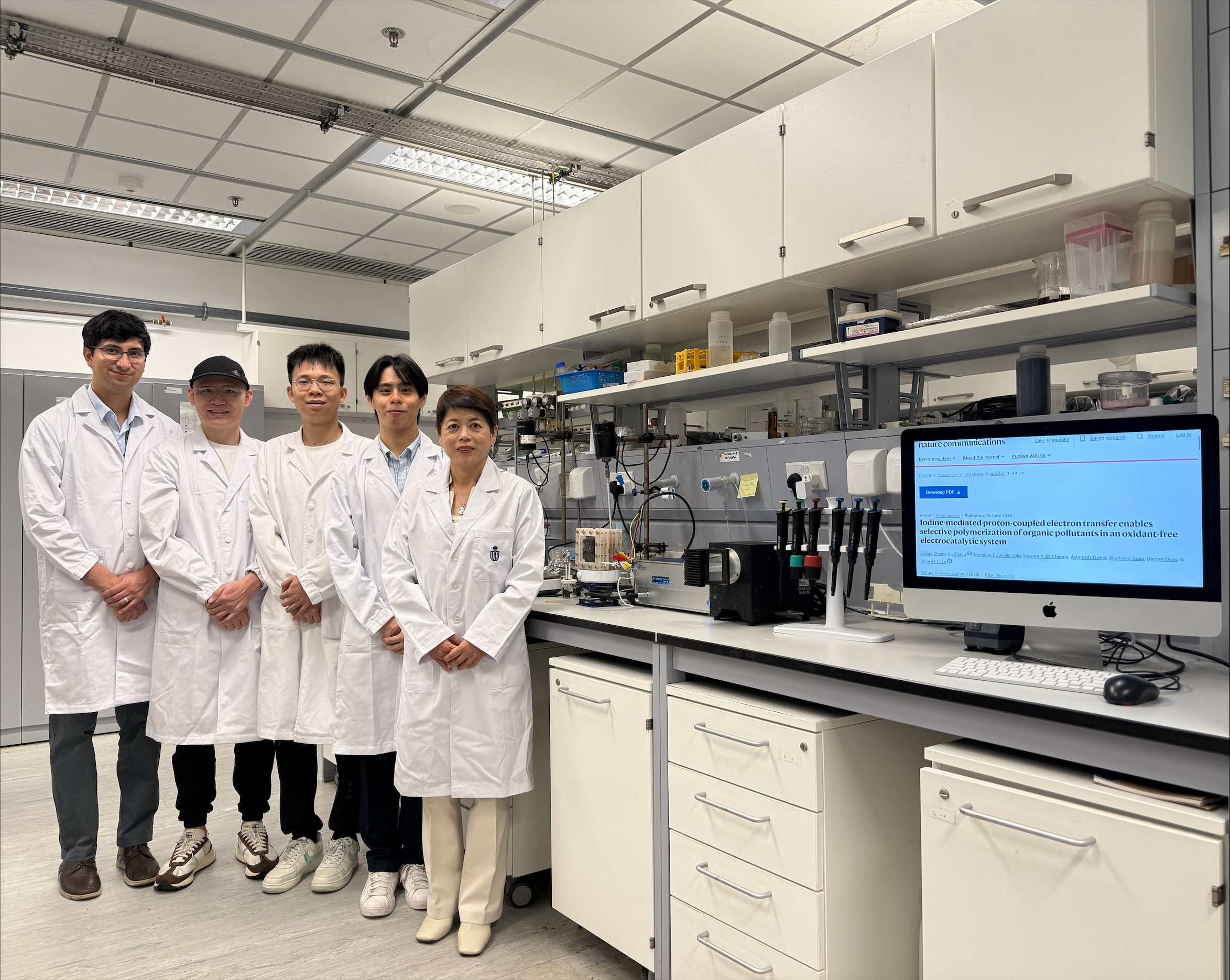
The HKUST research team—comprising Dr. ZHENG Zexiao, HKUST Research Associate, ZHANG Jin, PhD candidate, Dr. Jonathan J. CALVILLO SOLÍS, postdoctoral fellow, and Howard Y. M. CHEUNG, MPhil student alongside HKUST alumni Prof. Ashutosh KUMAR, Prof. GUAN Xiaohong, and Prof. DONG Haoran—is now considering the next frontier.
"As the next step, we look forward to scale-up investigations to assess the techno-economic feasibility and sustainability of this technology for real-world industrial applications," Prof. Lo says.
For HKUST, this research exemplifies the University's commitment to delivering transformative solutions at the intersection of environmental sustainability, public health, and economic viability. In reimagining how the world treats its wastewater, Prof. Lo and her team have redefined its purpose.