

Cooling the Future: HKUST Develops the World’s First Zero-Degradation Elastocaloric Cooling Device
Every time an air conditioner springs into action, it quietly fights a two-pronged battle: one against soaring energy demand and another against the planet’s climate.
That’s because traditional vapor-compression systems in such air-cons rely on energy-intensive processes and climate-altering refrigerants, making them a paradox of modern comfort.
Scientists have been exploring greener cooling technologies, including solid-state elastocaloric cooling, which harnesses the elastocaloric effect of shape memory alloys (SMAs) to deliver cooling without relying on conventional refrigerants. Yet a major obstacle has continued to hinder its practical deployment: functional fatigue. Over repeated cooling cycles, conventional elastocaloric materials gradually degrade, leading to a steady decline in cooling performance.
As a result, achieving long-term stability has remained a key bottleneck in the development of elastocaloric cooling technologies. HKUST researchers have now overcome this challenge, unveiling the world's first zero-degradation elastocaloric cooling system capable of maintaining peak performance over one million operational cycles.
Supporting the 5-year plan
This breakthrough comes at a pivotal moment for Hong Kong. The HKSAR Government’s historic First Five-Year Plan (2026–2030) announced in September 2026 explicitly prioritizes Hong Kong’s 'Green Transformation,' setting ambitious targets to reduce building energy consumption and accelerate the commercialization of local green tech R&D.
By translating advanced materials science into a viable, zero-degradation cooling prototype, the HKUST team is proactively helping advance the city's sustainability and green-transition objectives.
Shaping the Future
To appreciate the significance of HKUST's breakthrough, it is helpful to first understand the science behind elastocaloric cooling. Instead of compressing and expanding harmful greenhouse gases, this technology relies on the reversible, stress-induced phase transformation of SMAs. When the material is mechanically stressed, it releases heat; when the stress is removed, it absorbs heat, creating a cooling effect. It is an environmentally friendly cooling approach that avoids the use of conventional refrigerants with high global warming potential.
However, commercializing this technology faces hurdles. Over extended use, the internal microstructure of the industry-standard Nickel-Titanium (NiTi) SMA used as the refrigerant degrades, causing its cooling capacity to decline.
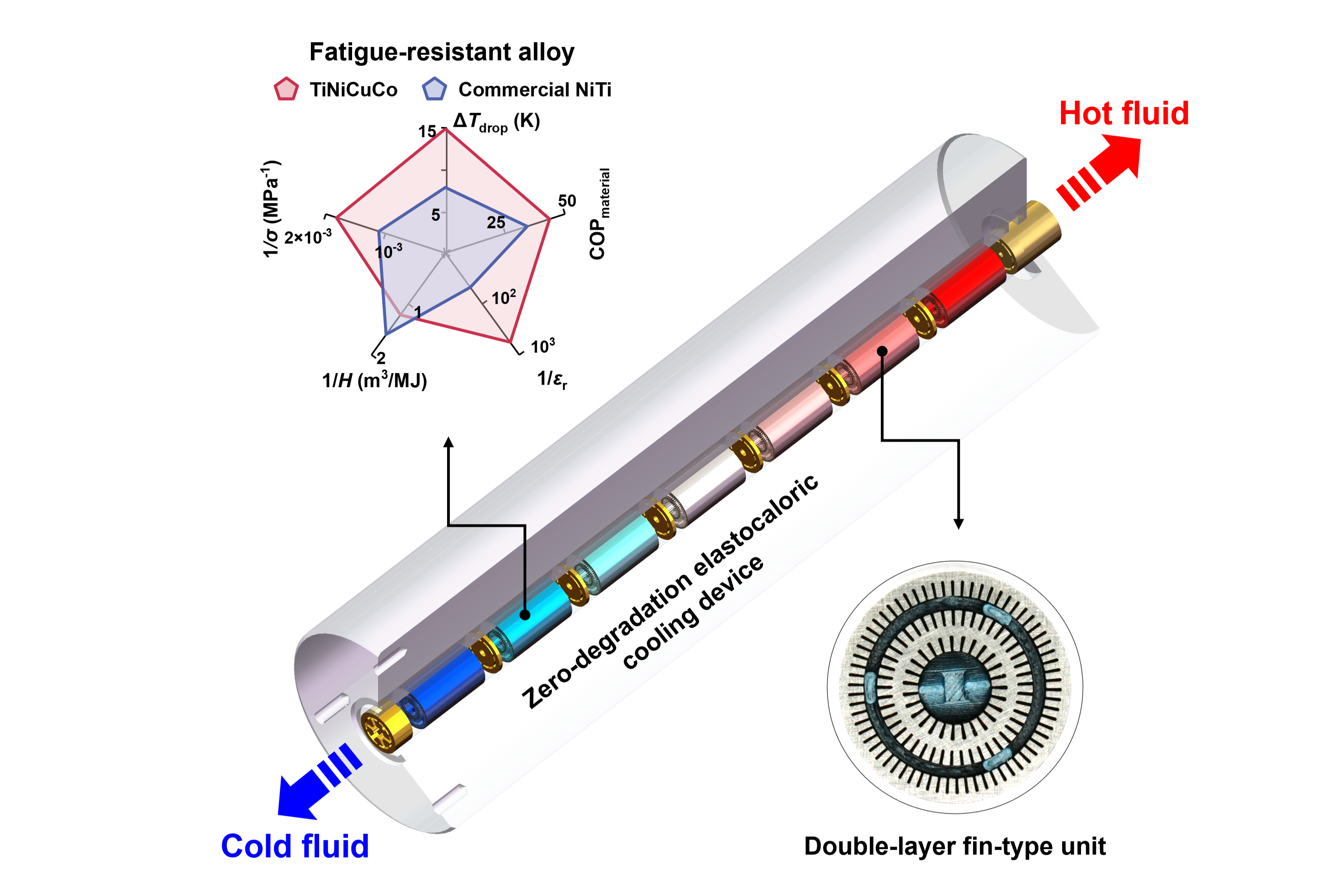
To overcome this problem, the HKUST team led by Prof. SUN Qingping, Chair Professor in the Department of Mechanical and Aerospace Engineering at HKUST, engineered a novel TiNiCuCo (Titanium-Nickel-Copper-Cobalt) alloy. By introducing copper and cobalt into the traditional NiTi matrix, they created a material that exhibits remarkable fatigue resistance. This new alloy provides highly stable elastocaloric performance, ensuring the consistent release and absorption of latent heat cycle after cycle. It is this atomic-level stability that underpins the device’s unprecedented longevity.
An Antidote to Fatigue
But a breakthrough material is only half the battle; it must be housed in a structure capable of withstanding immense mechanical stress. The HKUST team tackled this by designing a mechanically reliable, double-layer fin-type refrigerant structure. This innovative geometry not only maximizes heat transfer efficiency but also drastically improves buckling resistance. In isolation, this structural design achieved an ultra-high fatigue life, surviving over 10 million cyclic compressive tests.
Furthermore, the team optimized the overall device architecture to eliminate thermal losses and streamline system stability. Through meticulous engineering, they reduced the total number of components by 50% and slashed the proportion of "dead volume"—ineffective parts that do not contribute to cooling—from 15% down to just 5%.
The culmination of these material and engineering triumphs is a compact, highly efficient elastocaloric cooling device integrated with multiple refrigerant units. The performance metrics are a testament to the team's success:
- Constant Cooling Power: The device delivers a steady 400W of cooling power.
- Significant Temperature Span: It maintains a temperature span of 41 K (equivalent to a 41°C temperature difference).
- Zero Degradation: It sustains this peak performance over one million operational cycles without any drop in efficiency.
To put this into perspective, accelerated fatigue testing of the TiNiCuCo refrigerant material showed no functional degradation even after 100 million cycles. Under real-world, daily cooling conditions, the researchers estimate that the refrigerant material could operate reliably for more than a decade.
“This breakthrough in cooling stability, achieved at both the material and device levels, brings the technology one step closer to real-world applications beyond laboratory demonstrations,” said Prof. Sun.
Setting a New Global Standard for Sustainable Cooling
The team is currently developing a fully functional air-conditioner prototype based on this zero-degradation technology. Moving forward, their goal is to further enhance the energy efficiency, power density, and cost-competitiveness of elastocaloric systems to accelerate their adoption as a global standard for sustainable cooling.
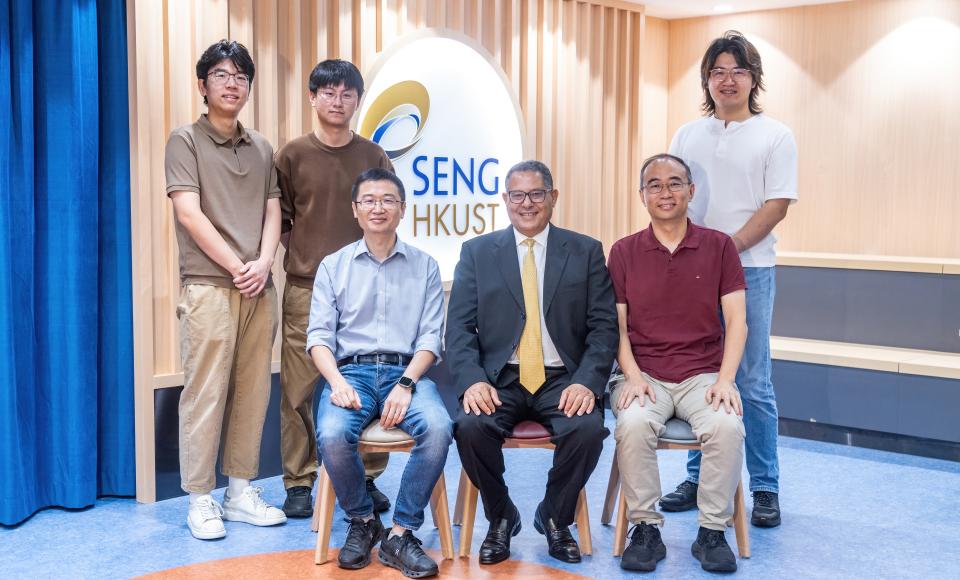
The findings of this study have been published in Joule, a leading peer-reviewed journal in the field of energy science. The paper, titled “A zero-degradation elastocaloric cooling device using fatigue-resistant refrigerant,” was co-authored by Dr. LIN Hongyang, a Postdoctoral Fellow in the Department of Mechanical and Aerospace Engineering at HKUST, and PhD student LI Yang, who served as first author. The multidisciplinary team also included vital contributions from Postdoctoral Fellow Dr. LI Xueshi and PhD students SU Changfeng and HU Jiyuan.
By transforming advances in materials science and mechanical engineering into practical solutions, HKUST is helping pave the way for a cooler, greener and more sustainable future.