





Designing Autonomous Wireless Networks That ‘Think’ Before They Transmit
Imagine a smart city where millions of autonomous vehicles, medical monitors, and industrial sensors are constantly exchanging data. Today’s wireless networks are built to deliver this data as accurately as possible. But in the near future, this sheer volume of information could create a serious bottleneck.
A research team at HKUST has proposed a groundbreaking framework for tackling this problem, one that seeks to teach machines to think before they speak.
Published in npj Wireless Technology, their "Reasoning-Empowered Task-Oriented Communication" (TOC) system enables AI agents to autonomously decide what information to share, when to share it, and why.
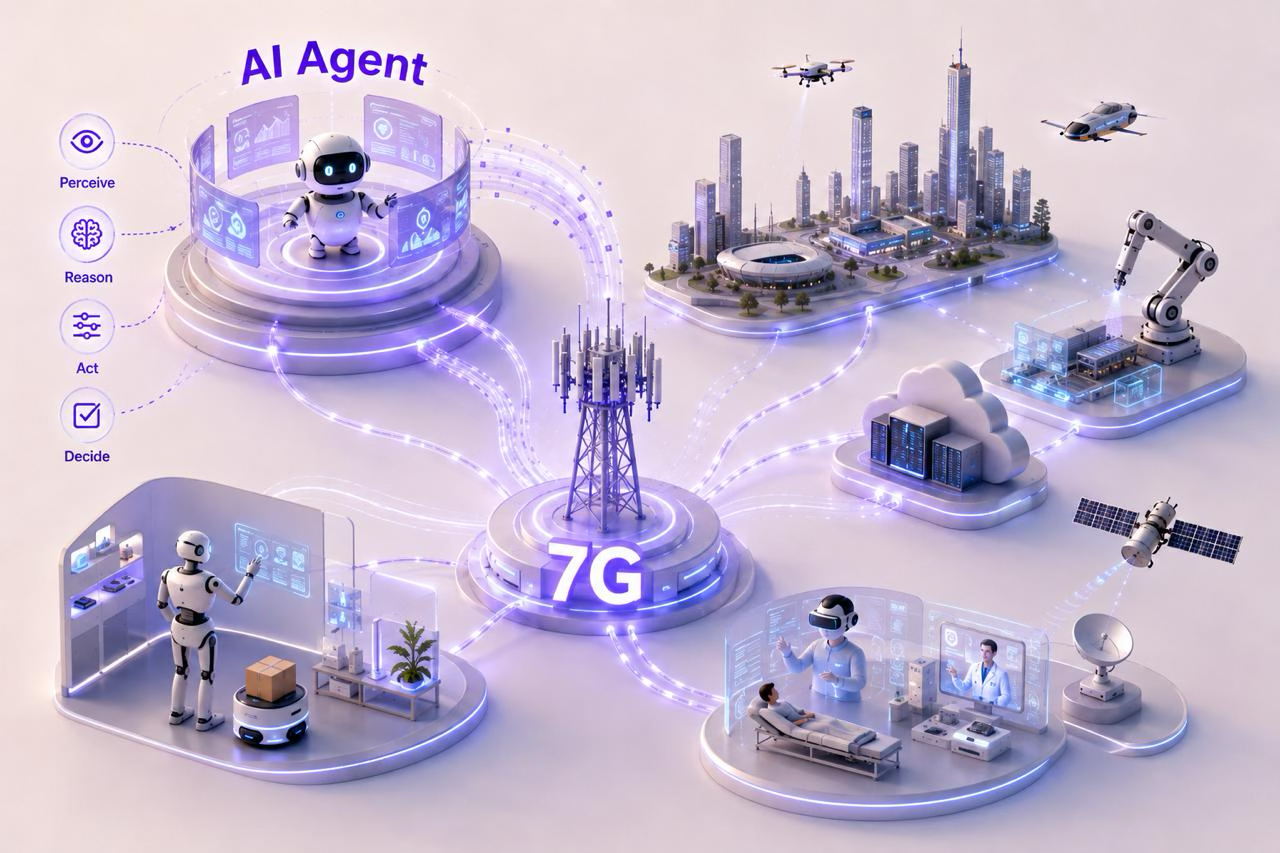
While the technology maps a vital roadmap for future 7G networks, its true value lies in its real-world applications. By shifting the focus from raw data transmission to purposeful communication, this framework unlocks the potential for true collective intelligence.
Take autonomous driving, for example. Instead of vehicles broadcasting terabytes of unfiltered sensor data to roadside systems, they would exchange only the critical insights needed to avoid hazards. In healthcare, clinical AI agents could filter out noise, prioritizing only the vital signals required for time-sensitive medical decisions. In manufacturing, digital twins could coordinate predictive maintenance to prevent costly production halts.
Such questions are highly relevant to the strategic drivers of AI development outlined in both the recent Policy Address delivered by the Chief Executive of the HKSAR and Hong Kong’s First Five-Year Plan. They highlight HKUST’s direct support for these Government initiatives.
"Tomorrow’s wireless networks will not simply connect devices. They will connect intelligence," said project leader Prof. Khaled BEN LETAIEF in the Department of Electronic and Computer Engineering (ECE). The team comprised ECE colleagues Prof. ZHANG Jun, Prof. SONG Shenghui, Dr. WANG Zixin, LI Hongru, and XIE Songjie.
So, how does an AI network "think"? The HKUST team designed a cognitive loop with three core capabilities. First, intent interpretation translates a broad objective—like "keep a video call stable"—into a specific communication goal. Second, automated optimization selects the best strategy, dynamically balancing communication performance, energy efficiency and user privacy. Finally, proactive foresight uses an internal "world model" to anticipate environmental changes before performance drops. Essentially, cognition guides communication, and communication strengthens collective cognition.
This research is a "compass" for 7G, not a finished standard, Professor Ben Letaief explained. It highlights the open questions the academic community must solve next, from scalable multi-agent coordination to trustworthy AI decision-making.
As we look beyond 6G, the challenge is no longer just how fast we can move data, but how intelligently we can share it. Thanks to this HKUST framework, the future of wireless networks isn't just about moving information—it's about enabling collective intelligence.