






We know that the bond between a teacher and a student can supercharge learning. But what if the “teacher” isn't human?
A recent study from HKUST, published in the neuroscience journal Neuron, suggests that a brief pre-class interaction with an AI can change how your brain prepares for learning.
This research, from the School of Humanities and Social Science (SHSS), provides the first neuroscientific evidence that AI-mediated interaction can match human instructor-student interaction in improving the quality of online learning. This offers a scalable AI-powered solution to make digital education more effective and less isolating.
Human vs. AI
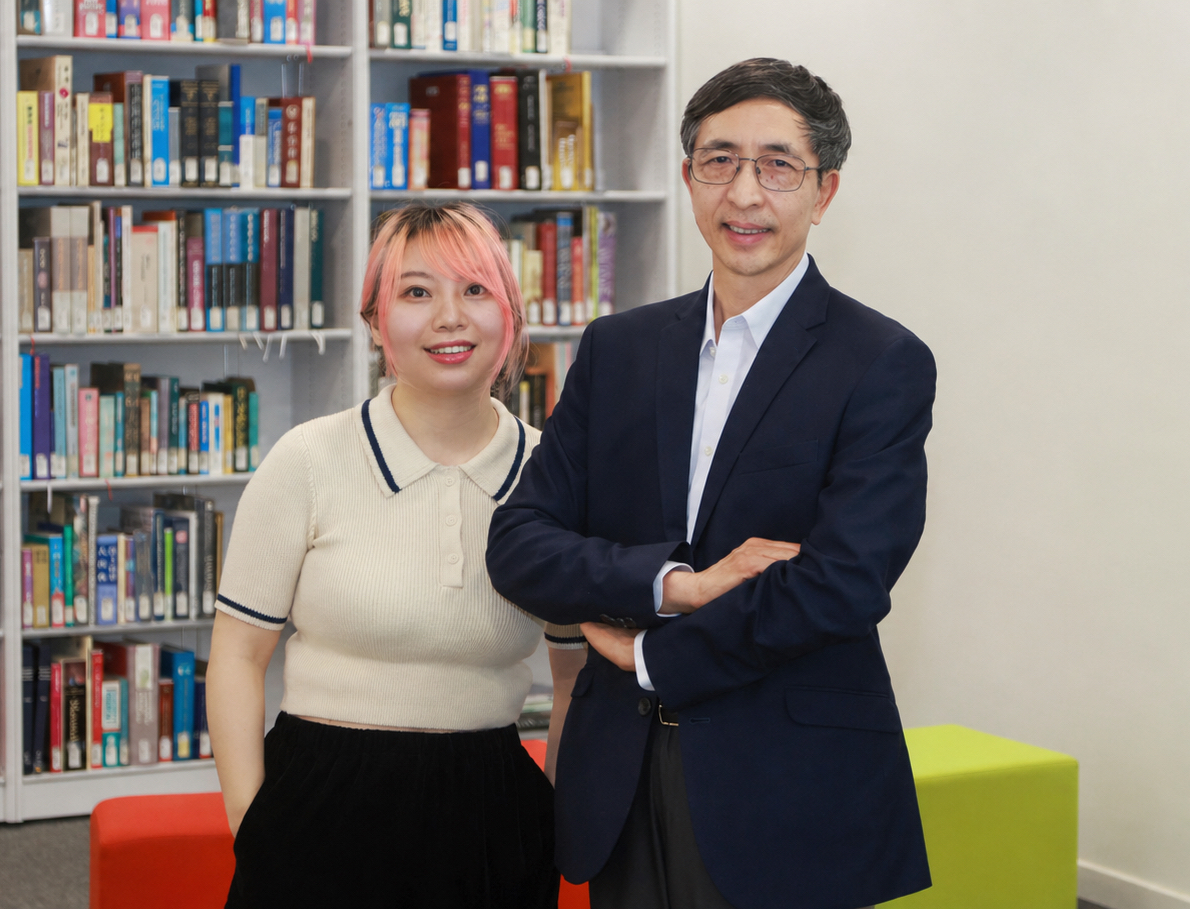
To understand how these pre-class interactions affect learning, an HKUST research team led by Prof. LI Ping, Dean of SHSS and Chair Professor of Psychology and Cognitive Science, conducted an experiment involving 57 university students randomly assigned to one of three groups:
• No Interaction Group – Students went straight into a video lecture, as most online learners do today.
• Human Interaction Group – Students had an 8- to 10-minute. face-to-face conversation with the human instructor before the video lecture.
• AI Interaction Group – Students had a conversation of the same length with an AI instructor powered by GPT-4, a customized avatar based on the human instructor’s voice and appearance.
The goal of these chats was not to teach the content early, but to serve as a social “warm-up”, including self-introductions, discussion of students’ interests and majors, and connecting those interests to the upcoming topic.
After that, all students watched the same 14-minute video lecture inside an MRI scanner. Their brain activity, eye movements, and learning outcomes were measured.
Neural Alignment and Learning Gains
The results were striking. The AI-led interactions could rival humans and yielded statistically indistinguishable learning outcomes.
During the video lecture, students from both the human and AI groups showed stronger neural alignment in the Default Mode Network. This part of the brain is active when we are in wakeful rest, or when we think about ourselves and others, remember the past, and plan. For this research, neural synchronization in this network has been linked to comprehension and understanding.
In the end, these students performed better on tests targeting memorization, understanding, and knowledge transfer of the video lecture content. The improvement was especially clear on challenging comprehension questions.
Essentially, the brief chat prepared and primed the students’ brains for more social and cognitive processing, helping them learn in a less passive, more engaged way. The no-interaction group, by contrast, showed weaker brain synchrony and lower learning gains.
Prof. Li said this means that short, casual conversations, even if they are AI-mediated, can sync people as they interact, with effects that persist in the subsequent processing of new information.
The study also tracked where students looked during the lecture. Students who had previously chatted with the human instructor demonstrated significantly higher gaze alignment. Their eye movements matched more closely with the teacher’s gaze and with one another.
This shared visual attention was linked to brain synchronization in the superior temporal sulcus, a brain region that supports language understanding and social perception, and, crucially, to better learning. It was also found that alignment in the posterior cingulate cortex related to cognitive control appeared to guide coordinated gaze behavior in a top-down manner.
Students who chatted with the AI instructor showed lower gaze alignment. Yet, surprisingly, their learning outcomes were just as strong.
The fact that the AI group showed strong alignment in cognitive control brain regions suggests that AI chats might help students focus more on analyzing f the content information itself.
AI and humans may boost learning through slightly different pathways, but both can still help students reach similar results.
Was AI as Good as a Human?
From a learning standpoint, yes.
That said, students reported feeling less socially close to the AI, even though it looked and sounded like the human instructor. The emotional bond was weaker, but the cognitive impact remained strong.
Therefore, AI does not need to perfectly replicate human warmth to be educationally effective. An advanced conversational AI can still deliver meaningful educational outcomes even when learners are fully aware of its artificial nature.
Dr. PENG Yingying, HKUST Postdoctoral Fellow and the paper’s first author, said this research reveals multiple routes to improving students’ online learning. Human interaction may boost learning through cognitive scaffolding and emotional and visual cues, while AI interaction may support more top-down cognitive processing.
One small but memorable moment during the experiment occurred when a participant coughed during their interaction with the AI instructor. The AI immediately responded: “I heard you coughing just now; please take good care of yourself.”
This moment left both the researchers and the participant struck by the level of care and warmth that AI systems can now deliver.
Scalable Solutions for the Digital Age
As AI continues to advance, understanding how it affects cognition and how the brain adapts will be critical for building learning environments that are scalable, human‑centered, and active.
A human instructor cannot personally chat with 1,000 students before a MOOC lecture, but an AI can.
By acting as a scalable social bridge, AI can help increase attention, improve learning outcomes, and ensure that online learning is no longer an isolating experience.
As Prof. Li explains, the future of education may involve AI systems that can pause, notice subtle attentional or emotional changes, and respond with empathy, helping students feel seen and heard, even in digital spaces.