







News & Stories
2026
Stories
Unveiling the Secrets of RNA Silencing
Boundless: What recent discovery has the HKUST research team made regarding the human enzyme DICER?Prof. Nguyen: Our discovery is genuinely groundbreaking. We found that the enzyme DICER, which is crucial for gene silencing, possesses a "dual-pocket" mechanism for measuring RNA. This is significant because it changes our understanding of how DICER interacts with RNA strands.Boundless: What exactly is “gene silencing”?Prof. Nguyen: Good question. Gene silencing means reducing or eliminating the expression of a specific gene. This process may occur naturally in cells or be induced artificially. Gene silencing is used to prevent the production of proteins from a targeted gene. This technique helps researchers study the function of a gene, investigate disease mechanisms, and develop gene-based therapies.

News
HKUST Researchers Achieve Breakthrough in RNA Silencing Mechanism
A research team from The Hong Kong University of Science and Technology (HKUST) has made a breakthrough discovery in understanding the molecular machinery of RNA silencing. The team uncovered how the human enzyme DICER achieves highly precise processing of microRNAs (miRNAs), advancing gene regulation research and offering new insights into the mechanisms underlying cancer, immune disorders, and genetic diseases.
2025

News
HKUST Researchers Uncover Key Transport Mechanisms in Cells, Shedding Light on Causes of Genetic Diseases
A research team led by Prof. GUO Yusong, Associate Professor of the Division of Life Science at The Hong Kong University of Science and Technology (HKUST) has made a significant breakthrough in understanding how cells manage the intricate internal transport of proteins, a process fundamental to life and implicated in several hereditary diseases. By employing an innovative vesicle proteomics platform, the team has systematically identified new cargo proteins and key accessory factors for two critical cellular transport complexes, AP-1 and AP-4. The findings, published in Proceedings of the National Academy of Sciences (PNAS), combine innovative vesicle reconstitution techniques with quantitative mass spectrometry-based proteomics to unveil a comprehensive map of previously unknown cargo proteins and regulatory factors.
2024

News
HKUST Researchers Uncover Mechanism for Short-distance Vesicle Movements
Researchers at the Hong Kong University of Science and Technology (HKUST) have thrown new light on the mechanism for how vesicles move short distances within specific parts of the cell, an area not understood by scientists.
Vesicles are small cellular containers that perform a variety of functions, including helping to move materials, such as proteins, lipids, and other cellular components, that an organism needs to survive and recycle waste materials.
Besides using molecular motors for long-distance transport, cells also need to move vesicles short distances within specific parts of the cell. But the exact mechanisms for this short-distance transport remain a topic of research among scientists.
2021
News
HKUST and PolyU researchers develop an in-vitro vesicle formation assay
Scientists from The Hong Kong University of Science and Technology (HKUST) and The Hong Kong Polytechnic University (PolyU) have developed an in-vitro vesicle formation assay, shedding light on cargo clients and factors that mediate vesicular trafficking and providing a robust tool to offer novel insights into the secretory pathway.
2020
News
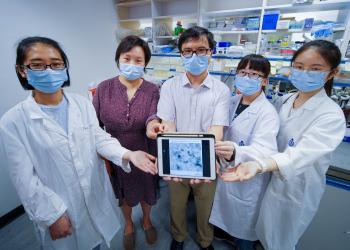
Researchers Uncover Novel Molecular Mechanism
Researchers from the Hong Kong University of Science and Technology (HKUST) discovered a novel molecular mechanism that controls the delivery of a key protein in planar cell polarity (PCP) – an important process in our body that regulates cell growth and cell movement, providing useful guidance on the development of new drugs for cancer treatment.
PCP is a biological process critical for tissue development and organ function. Defects in PCP could lead to illnesses such as neurological disorder, skeletal abnormalities or congenital heart disease. Even worse, cancer cells can hijack PCP to promote their own growth and expansion.
2019
News
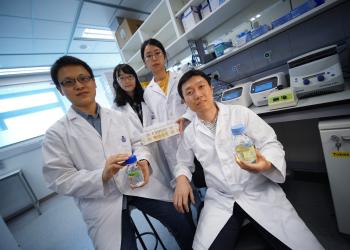
HKUST Researchers Discover New Virus Traits That May Help Fight Global Warming and Develop Anti-virus Drug
Oxygen levels in the ocean have depleted over the past few decades1 due to global warming and emissions of greenhouse gas, causing pollution and disrupting our ecosystem. In efforts to curb the trend, researchers from the Hong Kong University of Science and Technology (HKUST) discovered a mechanism that may eventually help an eco-friendly aquatic bacterium clean up more carbon dioxide in the ocean and produce more marine oxygen. Like trees on land, cyanobacteria, or what commonly known as blue-green algae, perform photosynthesis in the ocean. They provide oxygen for marine life and absorb over 20% of the world’s total carbon emission. However, natural predation and virus infection kill nearly half of the world’s cyanobacteria on a daily basis. A virus called cyanophage alone, wipes out one fifth of the total cyanobacterial population every day.
2017
News
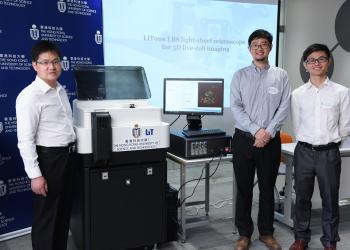
HKUST Discovers New Technology to Capture Live Cell Images Opening New Possibilities to the Study of Cell Biology
Researchers at The Hong Kong University of Science and Technology (HKUST) have developed a new generation of microscope, which not only could capture 3D live cell videos, but the resulted images are also of much higher quality, greatly enhancing the accuracy and the scope of research on cell biology.
While an existing confocal microscope can also capture 3D bio-images, the laser light hitting on the sample is typically one million times that of summer sunlight, such intense light exposure inevitably disrupts cell activities and eventually kills the cell, posing limits to the study of cell biology.