






HKUST Pioneers Novel Water Purification Technology for Selective Pollutant Polymerization
Enhances Pollutant Removal Efficiency and Potentially Doubles Economic Value Compared with Conventional Methods

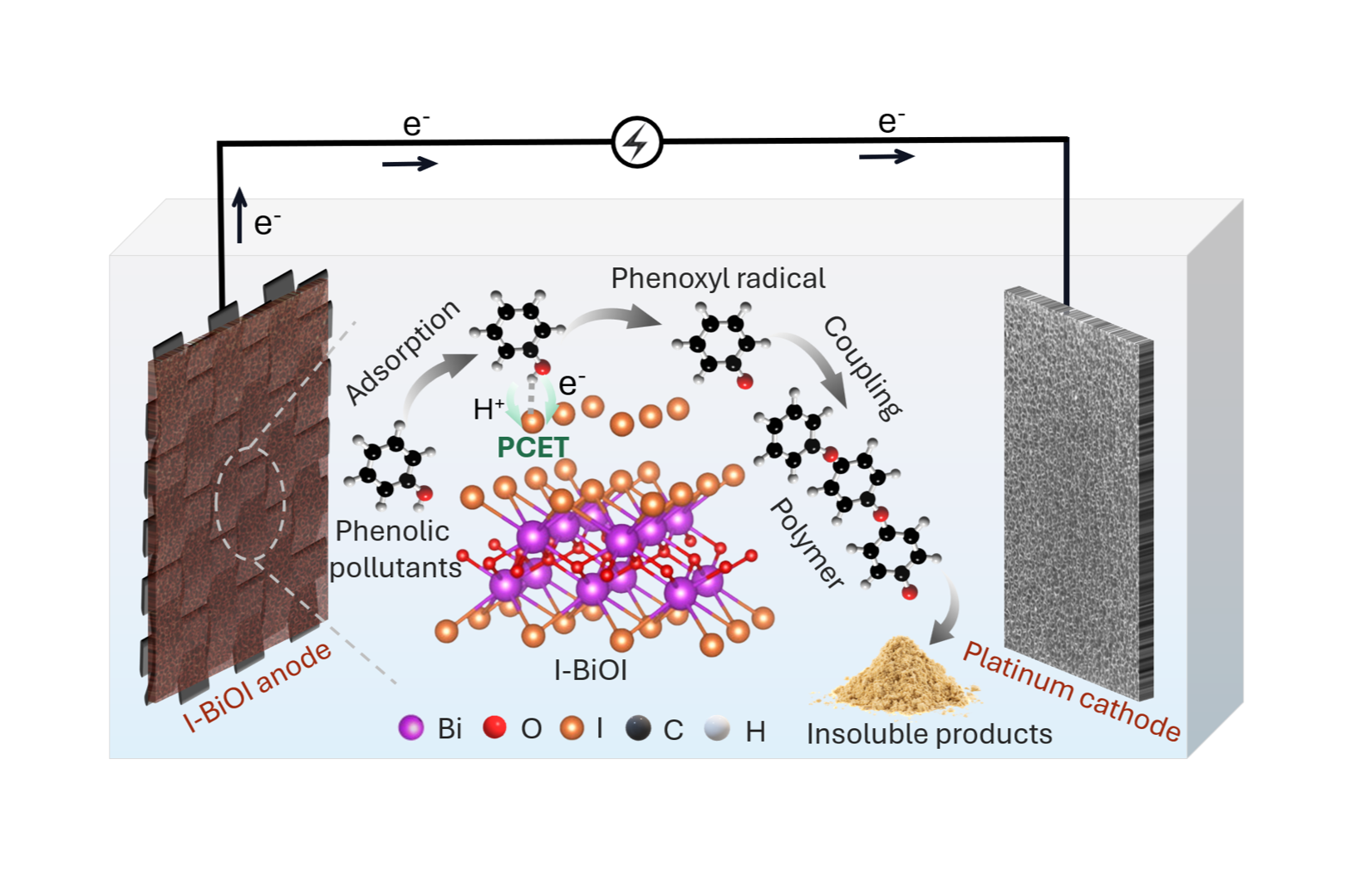
Wastewater treatment is a critical issue for global environmental protection and public health. Researchers from The Hong Kong University of Science and Technology (HKUST) have recently achieved a major breakthrough by discovering a novel oxidant-free electrocatalytic mechanism, opening up a new direction for water purification technologies. The findings are set to significantly improve pollutant identification efficiency and potentially double the economic feasibility compared with existing methods.
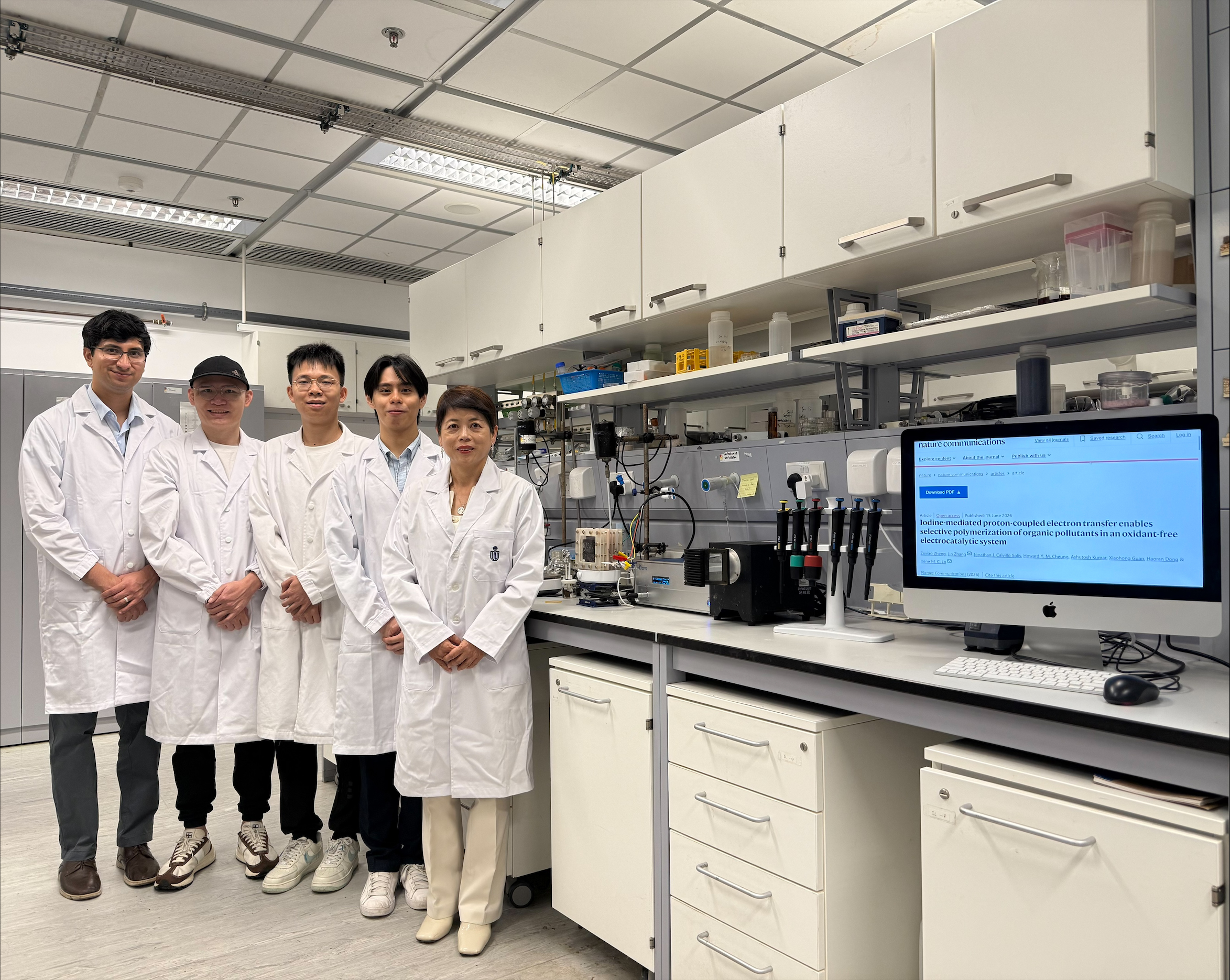
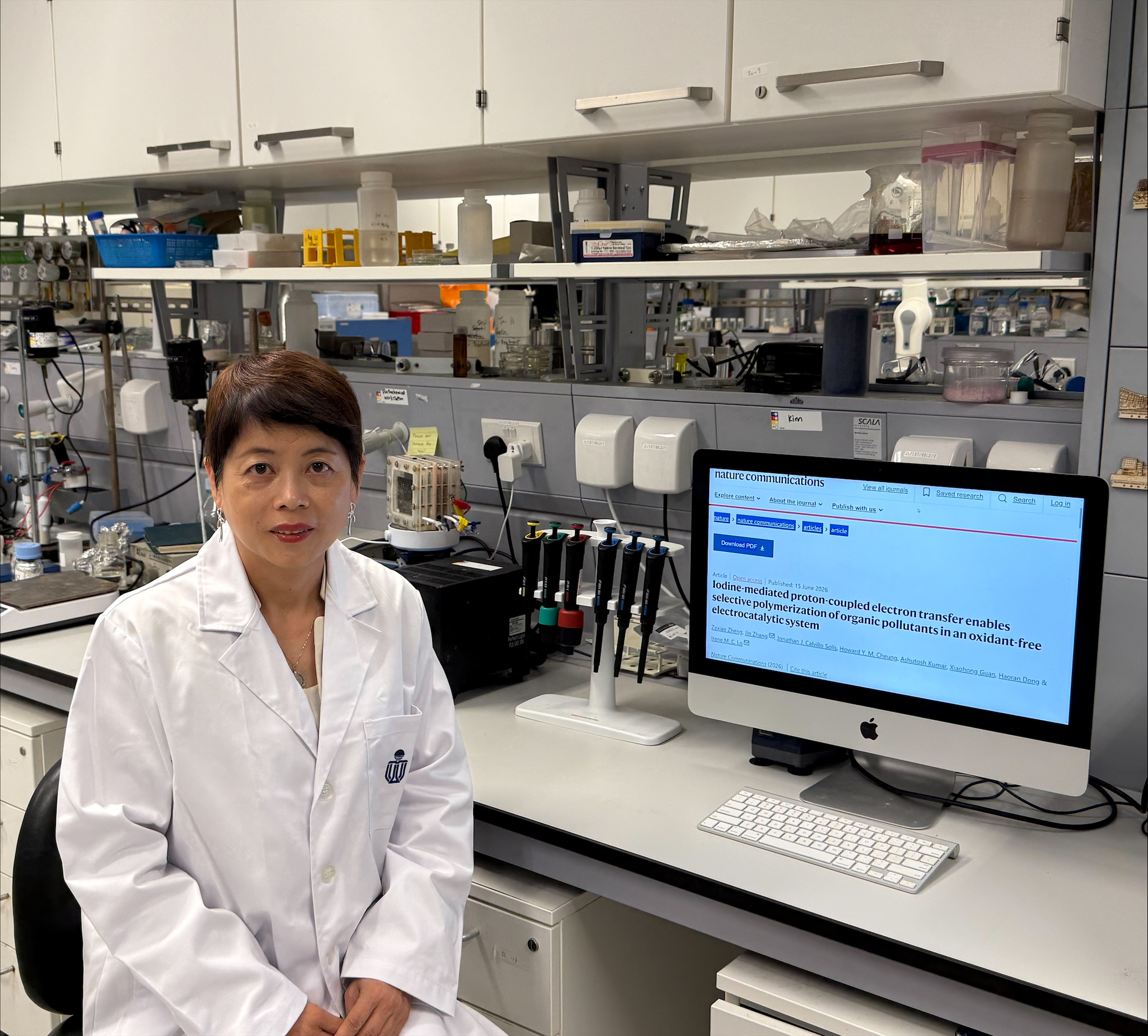
The research team, led by Prof. Irene LO Man-Chi, Chair Professor of the Department of Civil and Environmental Engineering at HKUST, has published the study in Nature Communications titled "Iodine-mediated proton-coupled electron transfer enables selective polymerization of organic pollutants in an oxidant-free electrocatalytic system". Members of the research team include HKUST Research Associate Dr. ZHENG Zexiao, PhD candidate ZHANG Jin, postdoctoral fellow Dr. Jonathan J. CALVILLO SOLÍS, and MPhil student Howard Y. M. CHEUNG, along with alumni Prof. Ashutosh KUMAR, Prof. GUAN Xiaohong, and Prof. DONG Haoran.
Advanced oxidation processes (AOPs) are widely used to degrade organic pollutants in wastewater. However, conventional AOPs typically require large amounts of oxidant, achieve only limited removal of total organic carbon (TOC), and generate toxic intermediate by-products. Although polymerization can address these problems by converting soluble phenolic pollutants into insoluble and hydrophobic polymerized products, the inefficiency of the process caused by a kinetic imbalance, together with its poor selectivity, poses key challenges.
Prof. Lo said, "A paradigm shift is needed to correct the kinetic imbalance and enhance selectivity, thereby unlocking the complete potential of polymerization processes for wastewater treatment. The key breakthrough of our work is that the newly discovered mechanism can transform harmful soluble contaminants by selectively polymerizing them into insoluble, value-added products, opening new pathways for environmental resource recovery."
Using a custom-engineered iodine-enriched bismuth-oxyiodide-coated carbon cloth (I-BiOI@CC) anode as a case study, the team found that highly selective polymerization arises from the synergy of two distinct transport dynamics. First, an iodine-terminated surface acts as a molecular hook, forming targeted hydrogen bonds (Hδ+···Iδ⁻) specifically with phenolic hydroxyl groups to ensure exceptional target affinity even in complex matrices. Meanwhile, under mild anodic polarization, surface iodine undergoes a highly stable, reversible redox transition (3I⁻ ⇌ I₃⁻).
The synergistic action of these two mechanisms creates an optimized electronic shuttle that smoothly captures electrons from the adsorbed phenols, causing localized radicals to self-couple through a thermodynamically favored ortho C–O coupling pathway. This coordinates a clean separation of recoverable polymers from the water, and at the same time completely avoids over-oxidation.
Prof. Lo noted, "By utilizing the coupled dynamics of proton and electron transfer, this electrocatalytic system enables polymerization with a high selectivity of 97.1%. We have effectively demonstrated that water treatment can be shifted from a destructive, chemical‑heavy process into a target‑selective, resource‑recoverable purification technology."
In terms of removal efficiencies, the system demonstrated uncompromised performance across broad pH bounds (pH 5-9) and complex chemical environments. It also nearly doubled the economic feasibility of treatment—by achieving an outstanding energy demand that is 2 to 4 orders of magnitude lower than that of mineralization-oriented counterparts.
The energy requirement of 2.93 kWh/kg TOC translates to an operational cost of just US$0.3 per kg of TOC removed, indicating strong potential for practical applications.
Beyond its economic viability, the new system excels in both operational and ecological safety. Simulations and experiments conducted by the research team showed that the absence of any external oxidants in operation significantly reduced secondary pollution risks and eliminated chemical shipping hazards, ensuring it can be employed safely across varying engineering conditions.
Furthermore, the present study establishes a more general sustainability model to predict environmental impact and ecological safety. While conventional life-cycle assessments focus primarily on carbon emissions in isolated domains, the research team evaluated this system across 18 distinct environmental impact domains, boasting a negative carbon footprint of 42.78 kg CO2-eq compared to standard Fenton systems. In 96-hour zebrafish embryo assays and Vibrio fischeri tests, the treated wastewater exhibited significantly suppressed biotoxicity, supporting healthy, normal development from embryo to fry, thereby providing a more universal physical standard for ecological protection.
Looking toward the future implementation of this framework, Prof. Lo concluded, "As the next step, we look forward to scale-up investigations to assess the techno-economic feasibility and sustainability of this technology for real-world industrial applications."
Sign Up for Our Latest News
Latest News
A research team led by Prof. QIAN Peiyuan, Chair Professor of the Department of Ocean Science at The Hong Kong University of Science and Technology (HKUST), in collaboration with international partners, has made significant progress in uncovering how deep-sea chemosynthetic symbioses cope with environmental change.
As climate change continues to intensify the frequency and severity of extreme weather events worldwide, a recent United Nations Environment Programme report warns that global temperatures are likely to exceed the 1.5°C threshold within the coming years, posing increasing risks to cities and communities around the world.
A research team from The Hong Kong University of Science and Technology (HKUST), in collaboration with Arizona State University (ASU) and The Hong Kong Polytechnic University (PolyU), has developed a sustainable integrated seawater-to-hydrogen system that can produce hydrogen directly from seawater while converting waste heat from electrolysis into a resource for producing the purified water required for hydrogen production. By integrating hydrogen pr