







HKUST Develops "One-Pot" 30-Minute High-Sensitivity At-Home Testing
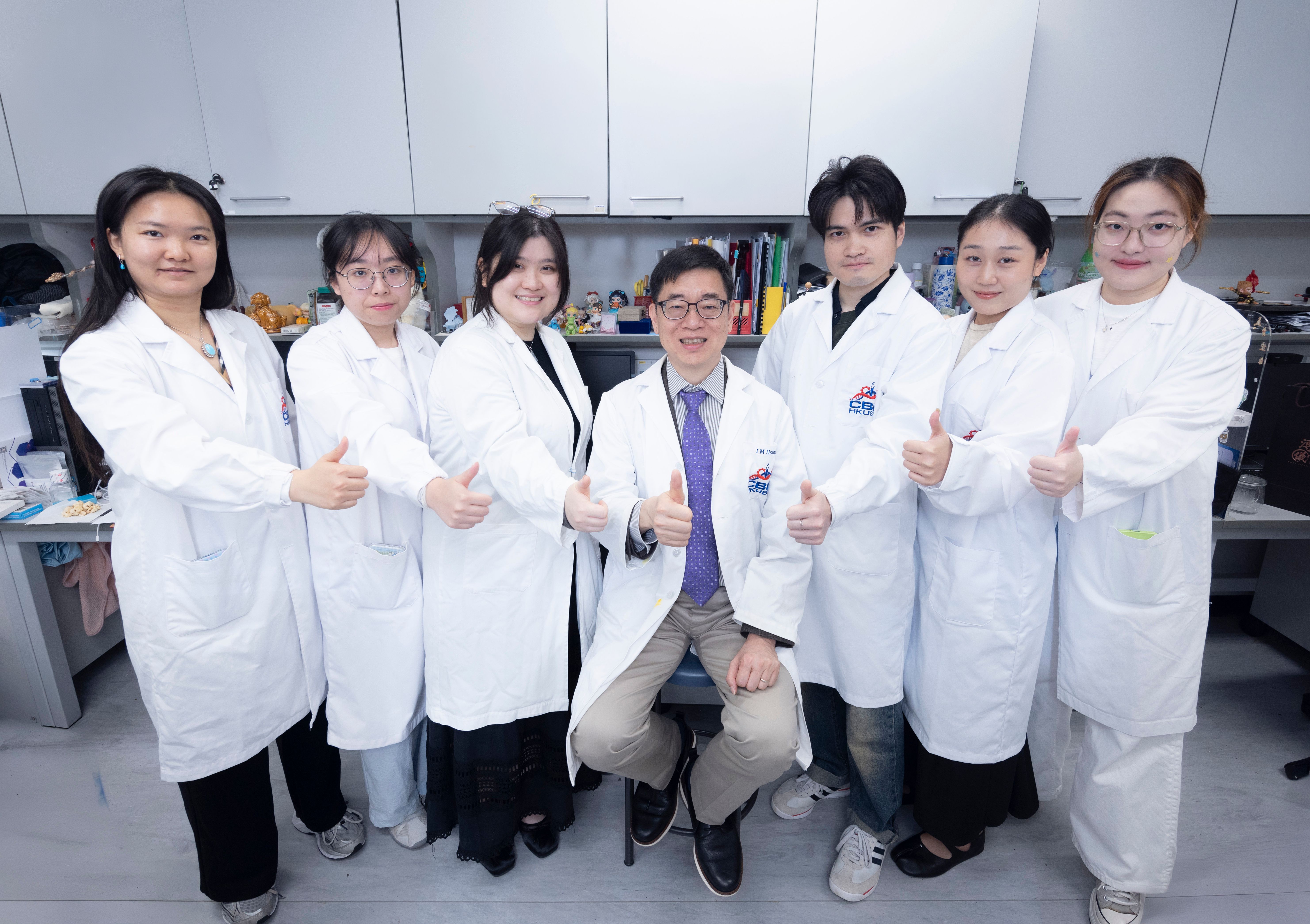
A research team from The Hong Kong University of Science and Technology (HKUST) has developed an innovative "one-pot" testing platform, known as TEMPO, that could transform highly sensitive nucleic acid testing from a laboratory-based procedure into a simple, single-step test that can be performed at home. With a single reaction tube, users can obtain results comparable to those of professional laboratory tests in as little as 30 minutes. The breakthrough has the potential to bridge the technological gap between existing rapid tests and laboratory-based nucleic acid diagnostics, offering a more convenient solution for future infectious disease surveillance and genetic screening.
TEMPO, short for "Thermodynamically Encoded Molecular Programming for One-Pot Diagnostics", was jointly developed by a research team led by Prof. HSING I-Ming, Professor of the Department of Chemical and Biological Engineering from HKUST and researchers from The Chinese University of Hong Kong (CUHK). The platform has already demonstrated applications in the detection of a range of viral infections, including influenza, COVID-19, and HIV, while also opening new possibilities for the rapid screening of hereditary diseases. The study, titled "Thermodynamically programmed one-pot CRISPR platform for point-of-care SNP genotyping", was published in the international journal Nature Communications.
Prof. Hsing, who led the research and is also the corresponding author of this study, noted, "Conventional laboratory nucleic acid testing involves multiple steps, including amplifying trace amounts of a pathogen's genetic material, identifying target sequences, and generating a readable signal. A 'one-pot' test integrates all of these processes into a single reaction tube. The greatest challenge lies in ensuring that each step takes place in the correct sequence."
To precisely control the sequence of reactions, researchers have previously attempted to adjust reagent concentrations, physically separate individual steps, or rely on manual intervention to coordinate the process. However, these approaches often lack robustness and are difficult to scale for widespread use. The HKUST team adopted a different strategy by harnessing the principles of thermodynamics to enable reactions to proceed automatically in a predetermined order. This provides a more stable and user-friendly means of controlling reaction timing, allowing nucleic acid tests that would normally require multiple steps to be performed in a single reaction tube.
Prof. Hsing said, "Think of it like cooking a complex dish in a single pot. The steps have to happen in the right order. In one-pot CRISPR tests, the process typically involves two key steps: nucleic acid amplification and CRISPR-based detection. These reactions compete for the same ingredients within a sealed reaction tube: amplification needs to build up the target, while the CRISPR enzyme immediately starts consuming it. Start the second step too early and the whole reaction stalls, making it difficult to achieve both speed and sensitivity in a single-step test."
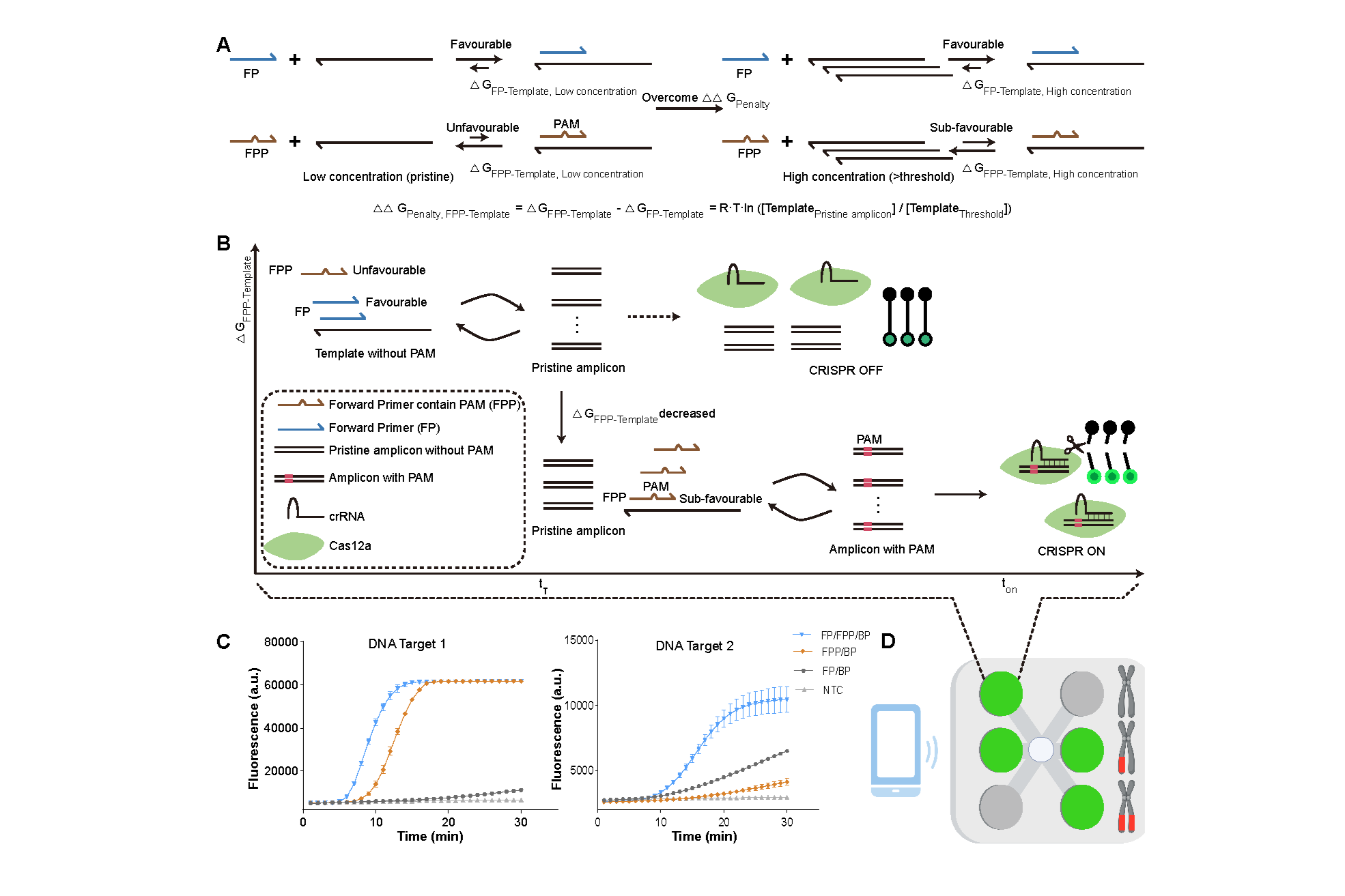
At the heart of TEMPO is a pair of thermodynamically engineered DNA primers. One "pristine" primer binds efficiently and drives the initial copying of the target. Its partner carries a deliberate, energetically unfavorable mismatch and stays quiet until enough target has accumulated to cross a defined thermodynamic threshold. Only then does the second primer engage, installing the molecular "start" signal, i.e., a protospacer adjacent motif (PAM) site, that switches on a programmable CRISPR enzyme and triggers a rapid, amplified readout. The team captured this behavior in a simple mathematical (ordinary differential equation) model that accurately predicted the delayed, threshold-dependent activation, turning primer design into a predictable engineering exercise.
An outstanding benefit of TEMPO is that it can reach genetic sites that conventional CRISPR diagnostics cannot, including the many clinically important single-nucleotide variants that lack a nearby PAM, while still distinguishing differences of just one DNA letter. This is because the CRISPR "start" signal is written into the primer rather than borrowed from the target's own sequence.
In testing, TEMPO reached attomolar (1 aM) sensitivity, comparable to gold-standard laboratory methods, in a 30-minute single-step workflow. The team validated the platform on simulated HIV samples with results fully concordant with quantitative PCR, and on real clinical specimens for Influenza A and SARS-CoV-2. They further integrated TEMPO into a single-step microfluidic chip and tested 20 human genomic samples for three clinically relevant single-nucleotide variants, obtaining results fully consistent with DNA sequencing.
Prof. Hsing remarked, "Relying on chemically stable DNA, this process does not require cold chain storage or complex handling. Furthermore, ultra-sensitive nucleic acid results are delivered in a single tube, eliminating the need for bulky instruments. Therefore, TEMPO is well suited to clinics, airports, homes, and remote settings. The advance clears a major hurdle on the road to reliable at-home and point-of-care testing."
In the face of future emerging infectious disease threats, TEMPO could provide a flexible platform that can be quickly reconfigured for new diagnostic targets. Because it is easy to use and does not rely on large instruments, the technology has the potential to bring high-performance testing directly into the home.
Beyond viral testing, the same single-nucleotide precision opens the door to simple screening tools for genetic traits and conditions, such as the common "alcohol flush" and alcohol intolerance among East Asian populations. The team is currently working to expand TEMPO to a broader panel of respiratory and sexually transmitted pathogens.
Looking ahead, the team plans to further develop a highly integrated sample-to-answer testing device for home and point-of-care settings within the next year. The researchers also intend to pursue a variety of clinical applications, including at-home testing for sexually transmitted infections, rapid molecular diagnostics for multidrug-resistant bacteria at the point of care, and genotyping tests for hereditary diseases such as thalassemia and conditions covered by newborn screening programs.
The ultimate goal is to establish an at-home nucleic acid testing platform that offers greater sensitivity and specificity than rapid antigen tests (RATs), while maintaining the same ease of use, thereby enhancing preparedness for future emerging infectious disease threats.
Sign Up for Our Latest News
Latest News

Turning climate science and early warnings into practical action to protect people, strengthen infrastructure and finance resilience is the focus of the Climate Adaptation and Resilience Conference 2026 (CARE2026) at The Hong Kong University of Science and Technology (HKUST). Running from 8 to 10 October, the conference opened with calls to connect scientific knowledge with better preparedness and decisions that make cities more resilient.


A research team led by Prof. QIAN Peiyuan, Chair Professor of the Department of Ocean Science at The Hong Kong University of Science and Technology (HKUST), in collaboration with international partners, has made significant progress in uncovering how deep-sea chemosynthetic symbioses cope with environmental change.