



Imagine a city where logistics, emergency rescues, and daily commutes glide seamlessly above the traffic, untethered by the constraints of crowded streets.
For a densely populated, hyper-connected metropolis like Hong Kong, the low-altitude economy (LAE) isn't just a futuristic concept. It is emerging as a vital frontier for urban transformation and economic growth.
By expanding development from ground space into airspace, the LAE promises to revolutionize how a smart city operates.
Furthermore, as an international gateway with a robust legal system and a world-class aviation regulatory framework, Hong Kong is uniquely positioned to bridge the Chinese Mainland’s technological capabilities and global standards, serving as a crucial "super connector" in this rapidly advancing global sector.
The Low-Altitude Economy Takes Flight
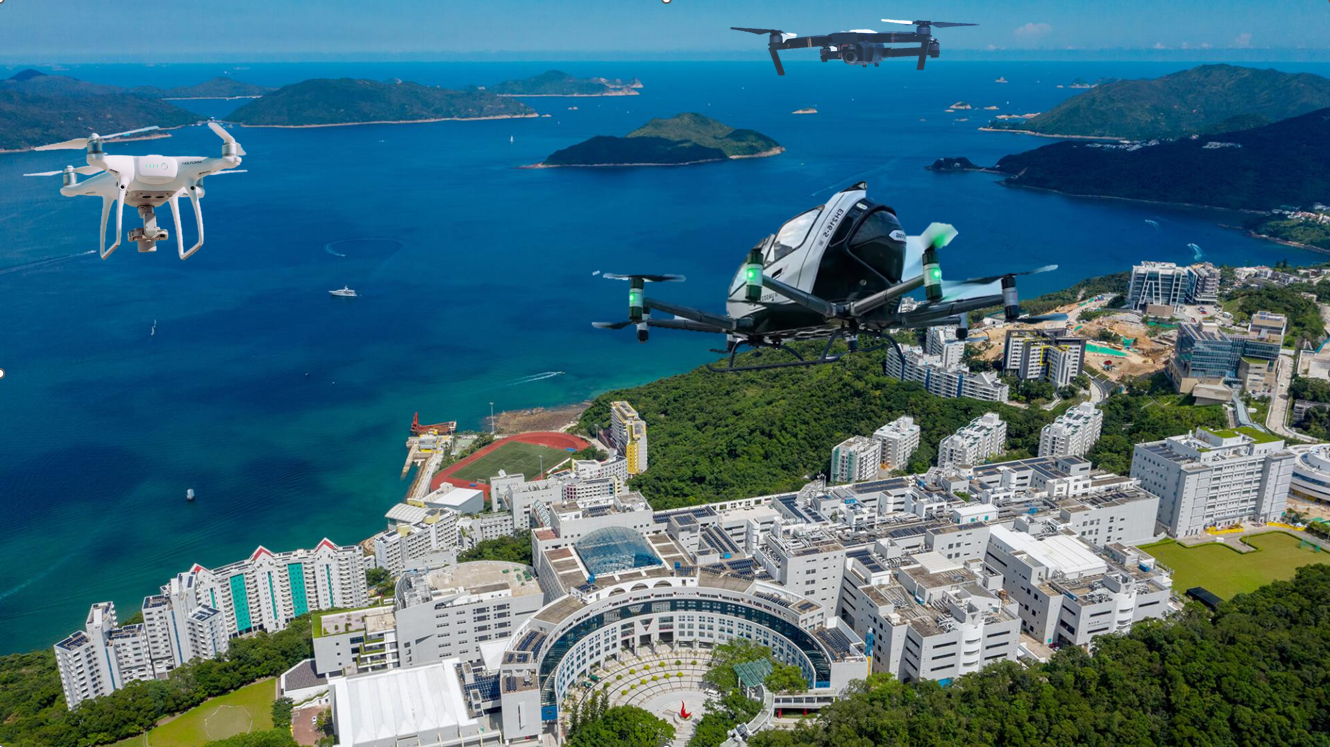
At the forefront of this aerial revolution, HKUST served as the official venue for the HKSAR Government's launch of the Low-Altitude Economy Regulatory Sandbox, reaffirming the University's role in advancing innovation and real-world applications in this emerging field. Through its Low Altitude Economy Research Center (LAERC), HKUST brings together engineers, AI experts, and policy scholars to tackle the complex pillars of the LAE, ranging from aerial systems and digital infrastructure to airspace routing and regulatory governance.
By providing essential testing grounds for pilot trials and validating cutting-edge technologies, HKUST serves as a crucial launchpad for Hong Kong’s ascent into the smart sky.
Bluesky Thinking
This pioneering vision took center stage at the recent forum, "Future of Low Altitude Economy: An Inter-City Dialogue on Commercialization and Standardization," co-hosted by HKUST, the HKSAR Government’s Working Group on Developing the Low-altitude Economy, and the Greater Bay Area Low Altitude Economy Alliance.
Bringing together over 300 global representatives, the forum explored the commercialization, standardization, and cross-sector collaboration needed to foster a robust LAE ecosystem.
In her welcome remarks, Prof. Nancy IP, President of HKUST, emphasized the city's strategic advantage and the University's pivotal role in realizing this vision.
"By bringing together innovation, industry, and talent, Hong Kong is well positioned to become a pioneer in this emerging sector and usher in a new era of the 'smart sky'. Supported by forward-looking government policies, a vibrant innovation ecosystem, and the immense opportunities presented by the Greater Bay Area, our city serves as an important bridge connecting the Chinese Mainland and the world," she said.
President Ip added that HKUST is committed to advancing the low-altitude economy through research, innovation, and collaboration.
“Over the past two years, we have actively supported Hong Kong's low-altitude economy agenda. HKUST was chosen as the venue for the Government’s official launch of the first batch of Low-Altitude Economy Regulatory Sandbox pilot projects. Through our Low Altitude Economy Research Center, the Regulatory Sandbox and Sandbox X pilot projects, we are driving cutting-edge research, technology testing, pilot applications, and Greater Bay Area collaboration in low-altitude technologies,” she said.
Intelligent Network for Smart Skies
HKUST will continue to work closely with government, industry, academia, and the wider research community to foster the knowledge, standards, and innovation ecosystem needed to support the sustainable growth of the low-altitude economy in Hong Kong and beyond, Prof. Ip continued. Echoing the President’s vision, government and industry leaders at the forum highlighted the practical steps required to turn the "smart sky" into reality.
Ms. Mable CHAN, Secretary for Transport and Logistics, noted the government's push to advance the "Regulatory Sandbox X" to safely test cross-boundary operations and unconventional aircraft.
Meanwhile, Prof. Tim CHENG, HKUST's Vice-President for Research and Development, underscored the importance of leveraging the Greater Bay Area's highly integrated supply chain to build a coordinated, intelligent network of unmanned systems across air, land, and sea.
Strengthening these collaborative efforts, forum representatives from across the globe—including delegates from Belt and Road nations—signed a Joint Statement of Intent on Low-Altitude Aviation Standards and Interoperability.
This initiative paves the way for the proposed International Low-Altitude Standards Association, aiming to align regional advancements with global standards-setting bodies and solidify Hong Kong’s position as a leading international hub for LAE standards.
The forum’s dynamic panel discussions delved into the LAE’s specific challenges, ranging from eVTOL certification and safety standards to maritime applications to the digital infrastructure required to support telecom-enabled aerial networks.
LAERC and Projects Taking Off
Underpinning these high-level discussions is the rigorous, on-the-ground research driven by HKUST’s LAERC, established in 2025 under the direction of Prof. LI Mo. This Center generates the data-driven insights to inform future regulatory frameworks and commercial applications.
Several groundbreaking HKUST projects are already making headway in the government's pilot programs. Prof. Li Mo’s team has secured major funding to develop critical testing infrastructure, including vertiports, sensing technologies, and comprehensive UAV flight-path monitoring systems such as OpenSILAS, as well as applications for UAV-enabled emergency rescue.
Concurrently, Prof. Hong K. LO, Dean of Engineering at HKUST, is spearheading efforts to develop a robust assessment framework for low-altitude routing across the Greater Bay Area, collaborating with Chinese Mainland partners on charging infrastructure for low-altitude logistics.
Other innovative projects at the University are tackling aircraft operational noise and deploying hydrogen-powered drones for long-range delivery. As drones and next-generation aerial vehicles become increasingly integrated into urban life, the technologies, standards and governance frameworks required to ensure their safe and efficient operation are taking shape, many of them through pioneering work at HKUST.
By bridging fundamental research and real-world applications, HKUST is helping lay the foundations for Hong Kong’s low-altitude economy. As innovation, policy, and industry converge, the city is steadily charting a course toward a smarter, more connected future in the skies.