





Maximizing Power Efficiency for the AI Age
For all its tangible benefits, AI is fast becoming an energy challenge, with experts calling for sustainable development of renewable energy, storage, and power semiconductors as AI demand grows. How can AI growth cope with these energy demands?
Data centers require vast amounts of electricity to power growth. They operate non-stop to power, cool, and connect thousands of high-performance servers that run the global internet and AI workloads. But how many of us consider sustainability and clean energy when we seek AI help in our personal, academic, and professional lives?
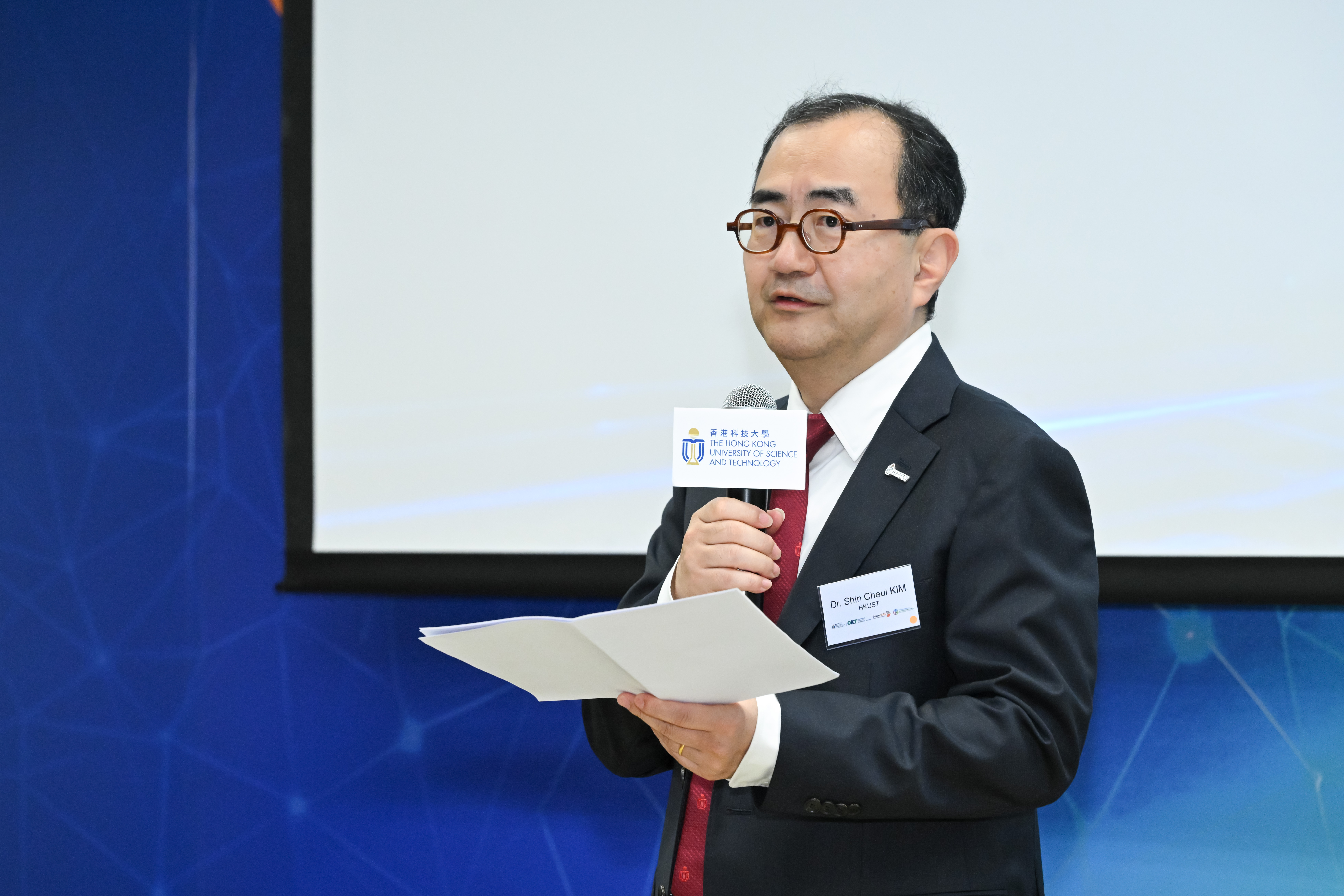
Speaking at a recent event titled “HKUST Industry Engagement Day Plus—From Smart Electronics to Clean Energy: Driving the Sustainable Future,” Dr. Shin Cheul KIM, Associate Vice-President for Research and Development (Knowledge Transfer), highlighted that the demand for energy as AI develops looks set to double.
“We all know that artificial intelligence uses a significant amount of electricity, with global data centers consuming around 415 terawatt-hours, which will reach 945 terawatt-hours by 2030,” said Dr. Kim.
Held on October 7, this Industry Engagement Day provided a timely opportunity for HKUST academics, industry insiders, investors, and tech companies to explore questions and uncertainties about power use and AI growth. Specifically, they focused on developing renewable energy, storage, and power semiconductors in response.
Reflecting on HKUST's specific contributions to these urgent issues, the heads of two new InnoHK research centers outlined how researchers and industry must work together to deliver more electricity with less energy loss, while generating and storing power without increasing dependence on fossil fuels.
The first is the InnoHK Power Semiconductors and Applications Center (InnoHK PowerSAC), which researches wide-bandgap semiconductors and compact power systems, and the second is the InnoHK Hong Kong Center for Renewable Energy and Storage (InnoHK HKCRES), which works on solar energy, green hydrogen, and safer batteries.
Prof. Kevin CHEN Jing, Head of InnoHK PowerSAC and Chair Professor in the Department of Electronic and Computer Engineering, emphasized in his address at the workshop the urgent need to minimize energy loss through smaller, more compact, and reliable power systems.
“InnoHK PowerSAC aims to meet the growing demand for sustainable and scalable power, electric power processing and delivery, while addressing a fundamental challenge of our time: how to deliver more electric power with higher efficiency and lower loss,” he said.
Prof. SHAO Minhua, Head of InnoHK HKCRES and Head and Chair Professor in the Department of Chemical and Biological Engineering, noted in his address how the critical need to address fundamental weaknesses within the energy sector, pointing out that approximately 75% of carbon emissions originate in the energy sector.
“It's essential for us to switch from fossil fuels to renewable energies in order to achieve carbon neutrality,” he argued. “But this energy switch requires suitable energy storage solutions. Our center's mission is to develop the technologies required to facilitate this transition.”
Both centers, which helped to co-organize the Industry Engagement Day with the Office of Knowledge Transfer, come under SEAM@InnoHK, the HKSAR Government’s third major research cluster, guided by the core foci of Sustainable (development), Energy, Advanced (manufacturing), and Materials.
The two InnoHK research centers bring together world-class research teams and industry leaders to work closely with HKUST researchers on frontier research in high-potential core areas, including renewable energy and advanced energy storage technologies, as well as power semiconductor chips and applications.
They serve to drive innovation in the green and low-carbon energy transition and advanced manufacturing, supporting Hong Kong's alignment with the national 15th Five-Year Plan's sustainability priorities while strengthening the city's strategic role in the new wave of global technological advancement.
The event was also an opportunity for HKUST to engage with key representatives from industry in the region, especially with experts from the semiconductor, energy, and battery sectors who discussed how wide-bandgap semiconductors—namely gallium nitride (GaN)—and next-generation energy systems could support AI, electric vehicles, and global decarbonization.
They agreed that sustaining rapid AI growth will require more diverse and resilient energy supplies. Potential solutions include green hydrogen, solid-state batteries, and widely available sodium-ion battery technologies, which could help address grid constraints and geopolitical risks associated with critical materials.
Dr. David ZHOU, Chief Scientist of the GaN Research Group at Shenzhen Pinghu Laboratory, and Dr. Gary TANG, Chief Technology Officer of CloudSemi Technology Co., Ltd., introduced the latest advances in GaN technology, which, in their opinion, are the compact, efficient power supplies that AI data centers now need.
In addition, Ir. Sammy KONG, General Manager of Commercial and Industrial Marketing & Sales at Towngas, and Dr. Dejun XIONG, Research and Development Director at Tianqi Lithium Grand Vision Energy Limited, shared developments in green fuel and lithium-cell technologies.
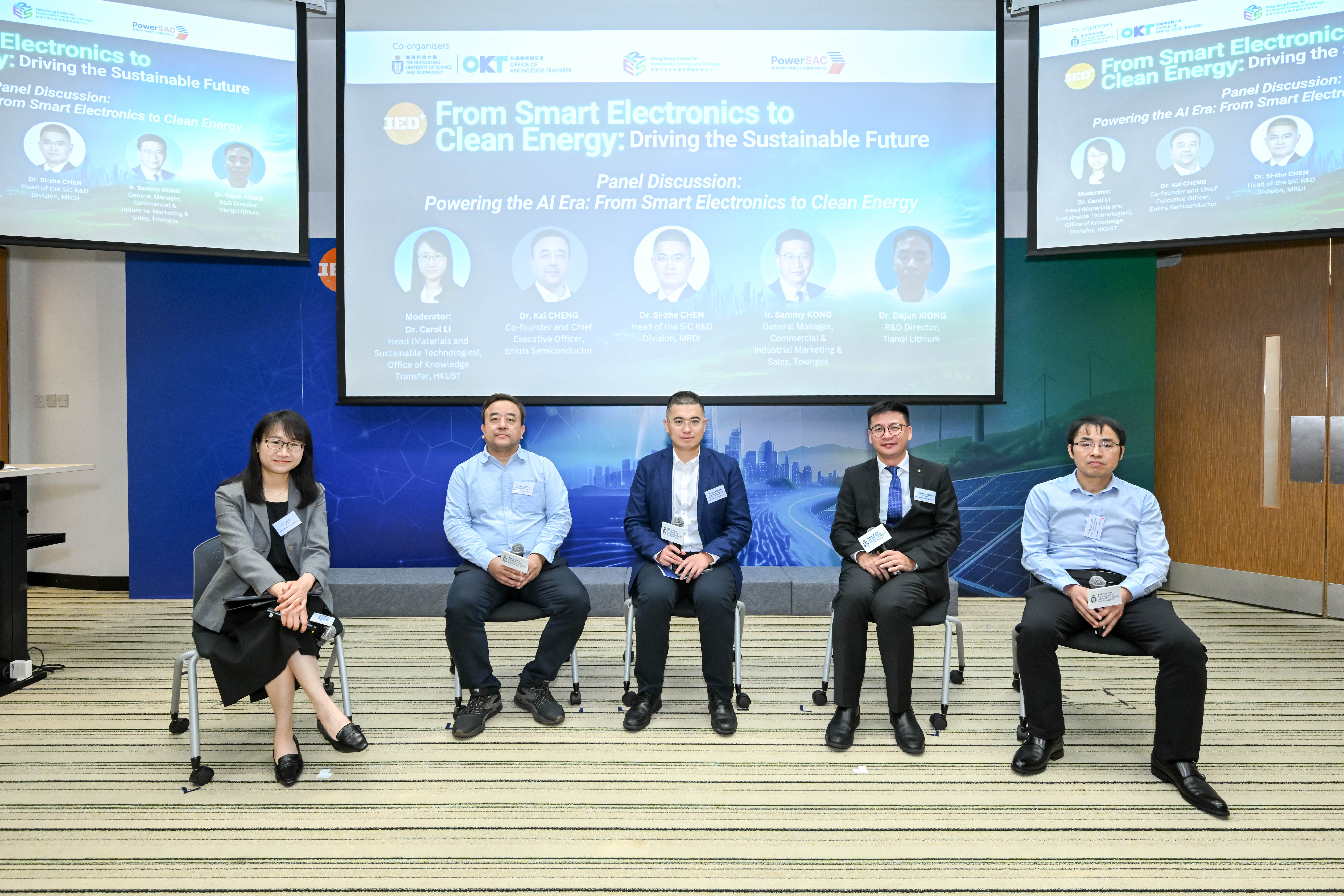
Concluding the seminar with an expert panel discussion, Dr. Carol LI, Head (Materials and Sustainable Technologies) at the Office of Knowledge Transfer, traced the evolution of efficient chip solutions with clean energy to sustain the development of AI’s future. Representatives joining this discussion comprised Industry partners including the Hong Kong Microelectronics Research and Development Institute (MRDI), Enkris Semiconductor and Tianqi Lithium, as well as Towngas, all of which have active cooperation with the University.
Together, they shared their views on how advances in semiconductors and energy solutions will affect AI development.
As Dr. Li concluded at the end of the day: “From semiconductors to energy, one message is very clear: building a sustainable AI future will require collaboration across the entire ecosystem.”
The main takeaway was that sustainable AI growth cannot rely on a single technology. Rather, it requires cross-disciplinary integration among universities, research institutes, industry, and the entire value chain.