





HKUST Researchers Redraw the Boundary between Phases of Matter
New Theory Unifies Magnets of Any Spin While Settling a Long-standing Puzzle Surrounding Water Ice under Extreme Pressure

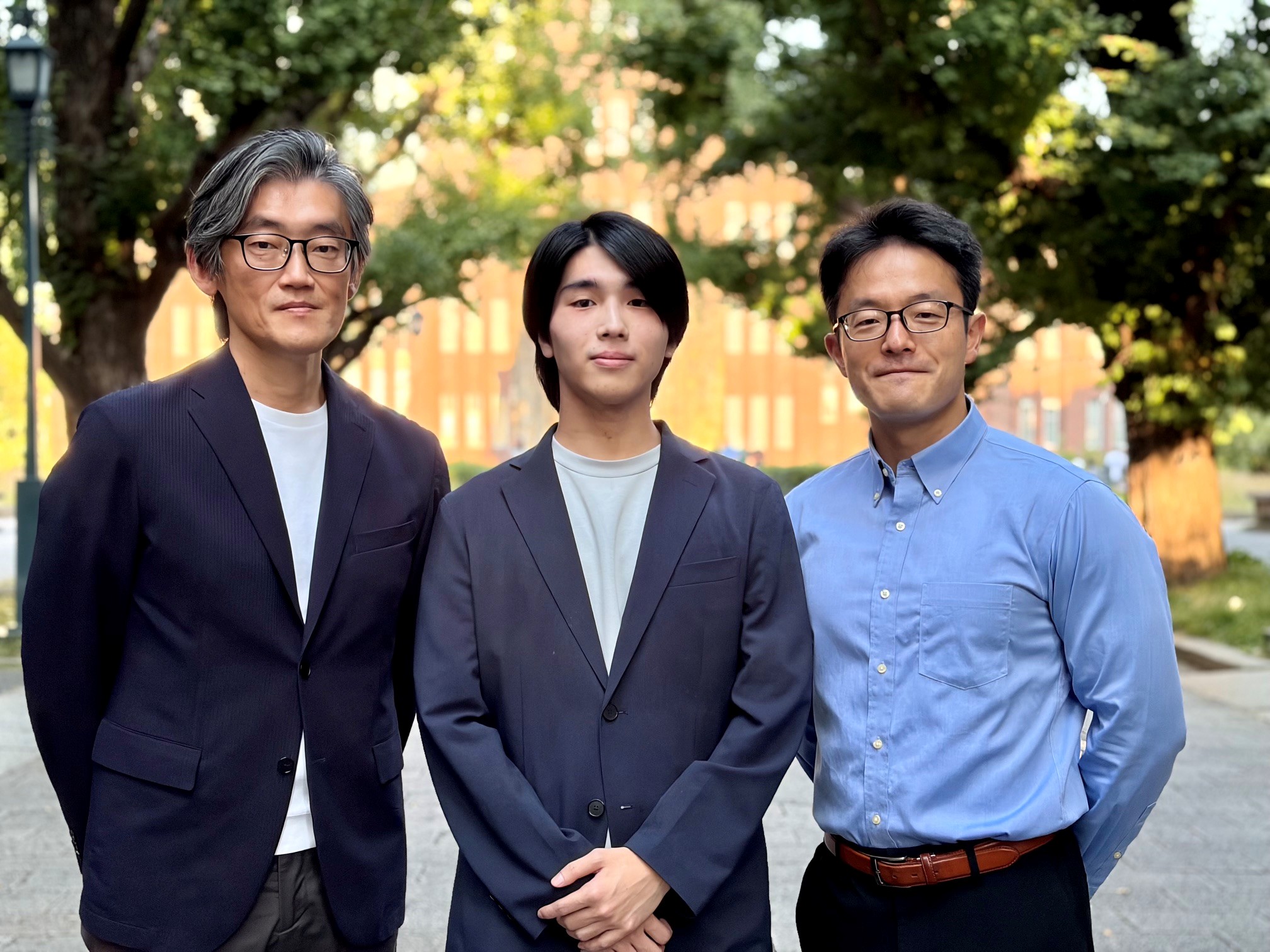
A research team led by Prof. Haruki WATANABE, Professor in the Department of Physics and the Jockey Club Institute for Advanced Study (IAS) at The Hong Kong University of Science and Technology (HKUST), in collaboration with Prof. Yukitoshi MOTOME and graduate student Sena WATANABE from the University of Tokyo, has developed a unified theory that predicts when two states of matter are genuinely distinct and when they are secretly the same. The breakthrough provides a general framework for classifying phases across magnetic systems with different spin values and resolves a long-standing debate surrounding the behavior of water ice under extreme pressure. The paper titled “Topological phase transitions and their thermodynamic fate in arbitrary-𝑆 classical pyrochlore spin ice” was published in Physical Review X.
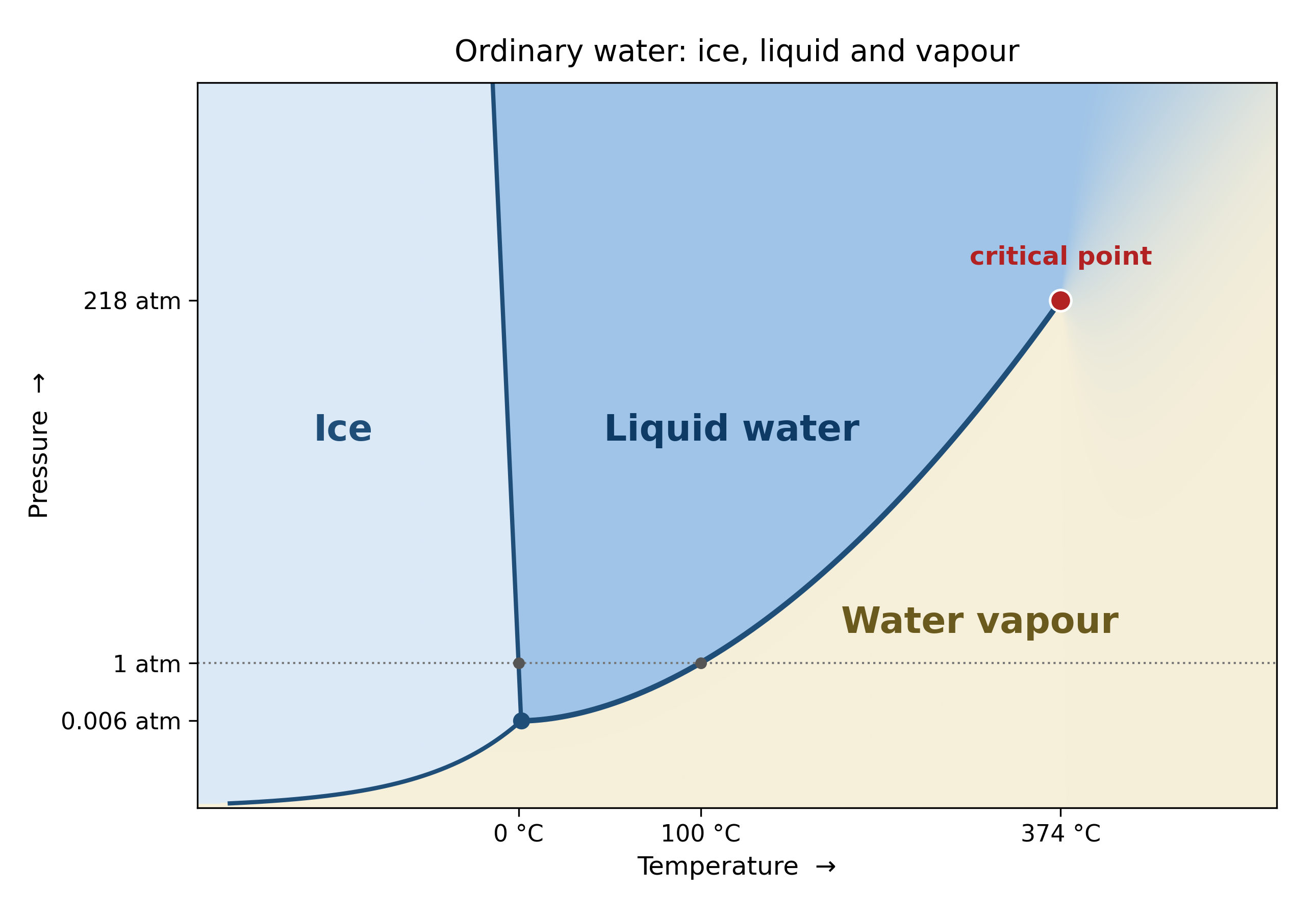
Whether phases of matter are separated by a sharp boundary often depends on symmetry. For example, while liquid water and steam are commonly regarded as different states, they actually share the same underlying symmetries—meaning their molecules have no preferred position or direction. As a result, they can be continuously transformed into one another beyond a specific critical point, making them a single thermodynamic phase (Figure 1). Ice, by contrast, forms a crystal lattice in which molecules occupy fixed positions, breaking a symmetry preserved by liquids and gases. Because these symmetries differ, ice must remain separated from liquid by a genuine phase boundary.
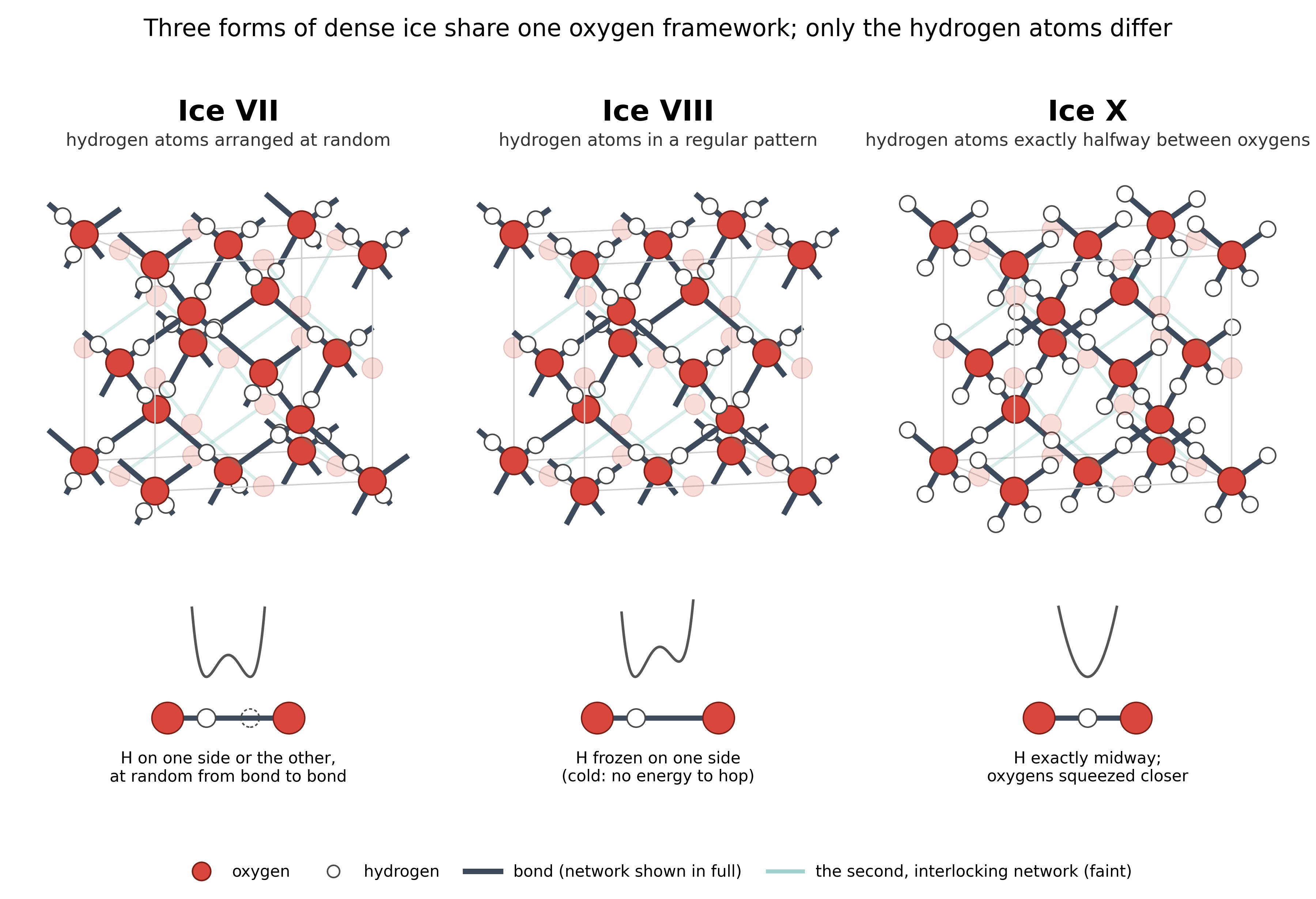
The researchers applied this principle to high-pressure forms of ice, including ice VII, ice VIII, and ice X (Figure 2). These forms share the same framework of oxygen atoms but differ in the arrangement of their hydrogen atoms. In ice VII, hydrogen atoms occupy random positions, while in ice VIII they adopt an ordered arrangement, and in ice X they are located midway between neighboring oxygen atoms. Despite these differences, and averaged over time, ice VII and ice X preserve the same underlying crystal symmetries, creating long-standing uncertainty over whether they represent distinct phases of matter or different manifestations of the same phase.
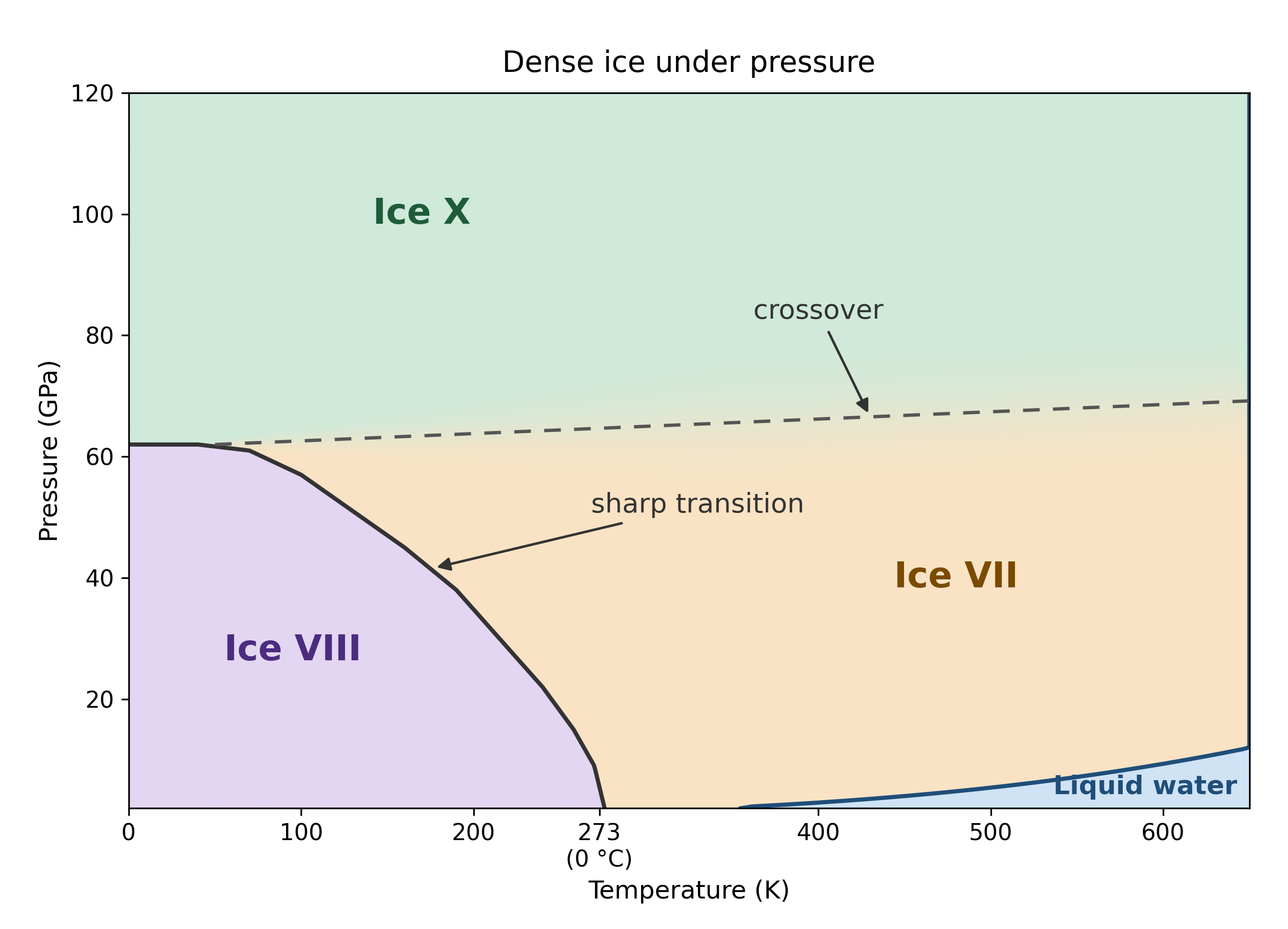
To address this question, the team recast the problem as magnetism. The midpoints of the bonds between oxygen atoms form a pyrochlore lattice, the structure behind the celebrated “spin ice” magnets, and the three positions open to each hydrogen atom are exactly the three states of a magnetic moment of spin 1. A related study led by the team, published in Physical Review B, showed that, in a simplified model excluding ice VIII ordering, ice VII and ice X are separated by a sharp transition only at absolute zero. At any temperature above it, thermally excited defects act like magnetic monopoles and screen the field that holds the two states apart, dissolving the sharp transition into a gradual crossover. As a result, ice VII and ice X belong to the same phase. Ice VIII, by contrast, remains distinct because its ordered hydrogen arrangement breaks an underlying crystal symmetry (Figure 3).
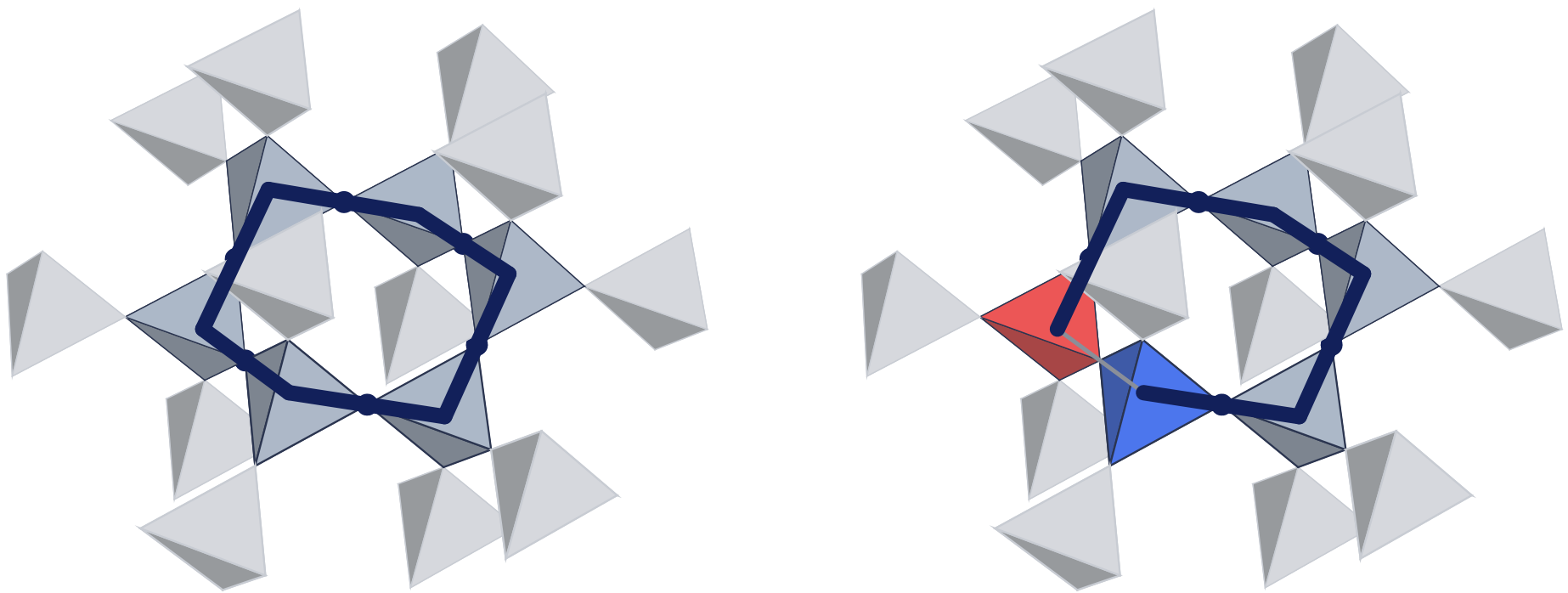
Building on this result, the team's primary paper in Physical Review X establishes a general framework for classifying phases and phase transitions in classical pyrochlore spin-ice models with arbitrary spin values. The study shows that what keeps two states apart is a network of string-like defects threading the crystal (Figure 4): so long as those strings close on themselves, the two states remain genuinely different. The framework also reveals a sharp divide that earlier work could not see: magnets whose spin is a whole number behave qualitatively differently from those whose spin is a half-integer. Above absolute zero, thermally excited monopoles cut the strings open, and once they are severed the distinction is washed out, so almost every sharp phase boundary gives way to a smooth crossover. The sole exception is spin 3/2, where an abrupt transition between two distinct liquid-like magnetic states is predicted to survive at finite temperature and end at a critical point without the need for an external magnetic field, making it an especially promising target for future experiments. The findings provide a unified framework for understanding how phases of matter emerge, persist and transform, with implications for frustrated magnets, nanomagnet arrays and trapped cold-atom systems.
Reflecting on the findings, Prof. Watanabe remarked, “Our results ultimately support the conventional view that the phases of ordinary matter are classified by broken symmetry, and by nothing else. Wherever symmetry could not distinguish between two states, a continuous path connected them without crossing a phase boundary. It would be far more interesting to discover a topological phase that genuinely survives at a finite temperature beyond this classification. That is what we are looking for now.”
About The Hong Kong University of Science and Technology
The Hong Kong University of Science and Technology (HKUST) (https://hkust.edu.hk/) is a world-class university renowned for its excellence in innovative education, research, and impactful knowledge transfer. Adopting a holistic and interdisciplinary approach to education, HKUST was ranked 33rd globally and 6th in Asia in the QS World University Rankings 2027 and QS Asia University Rankings 2026, respectively. It was also ranked 20th worldwide in the Times Higher Education Sustainability Impact Ratings 2026, placing first among universities in Hong Kong and the Chinese Mainland for the third consecutive year. Eleven HKUST subjects were ranked among the world's top 50 in the QS World University Rankings by Subject 2026. In addition, HKUST's Computer Science discipline, which encompasses areas such as artificial intelligence and machine learning, was ranked No. 1 in Hong Kong for the tenth consecutive year in the Times Higher Education World University Rankings by Subject 2026. Its graduates are highly competitive, consistently ranking among the world's top 30 most sought-after employees. In research and entrepreneurship, more than 80% of HKUST's research was rated "world-leading" or "internationally excellent" in the University Grants Committee's Research Assessment Exercise 2020. As of September 2026, HKUST members have founded more than 2,000 active start-ups, including 11 unicorns and 23 successful exits through initial public offerings (IPOs) or mergers and acquisitions (M&A).
For media enquiries, please contact:
Public Affairs and Global Communications Office
Email: media@ust.hk
Sign Up for Our Latest News
Latest News

The Hong Kong University of Science and Technology (HKUST) has successfully concluded the "Jobs and Development Conference 2026". As one of the signature events marking HKUST’s 35th anniversary, this year’s edition of the flagship international conference was held in Asia for the first time.
The Kellogg-HKUST Executive MBA (KH EMBA) Program has secured the No. 1 position globally in the Financial Times Executive MBA Ranking 2026, released today, marking an unprecedented 13th time the program has attained the top position.

The Hong Kong University of Science and Technology (HKUST) has once again demonstrated its global research excellence in Stanford University's latest World's Top 2% Scientists ranking. A total of 244 and 205 HKUST scholars were featured in the Single-Year Impact and Career-Long Impact lists, respectively, accounting for approximately 40% of the University's tenure-track faculty.