





HKUST Launches Next-Generation Interactive WavyOcean 3.0 Platform
Connecting Research and the Public through the "Taohai" Concept

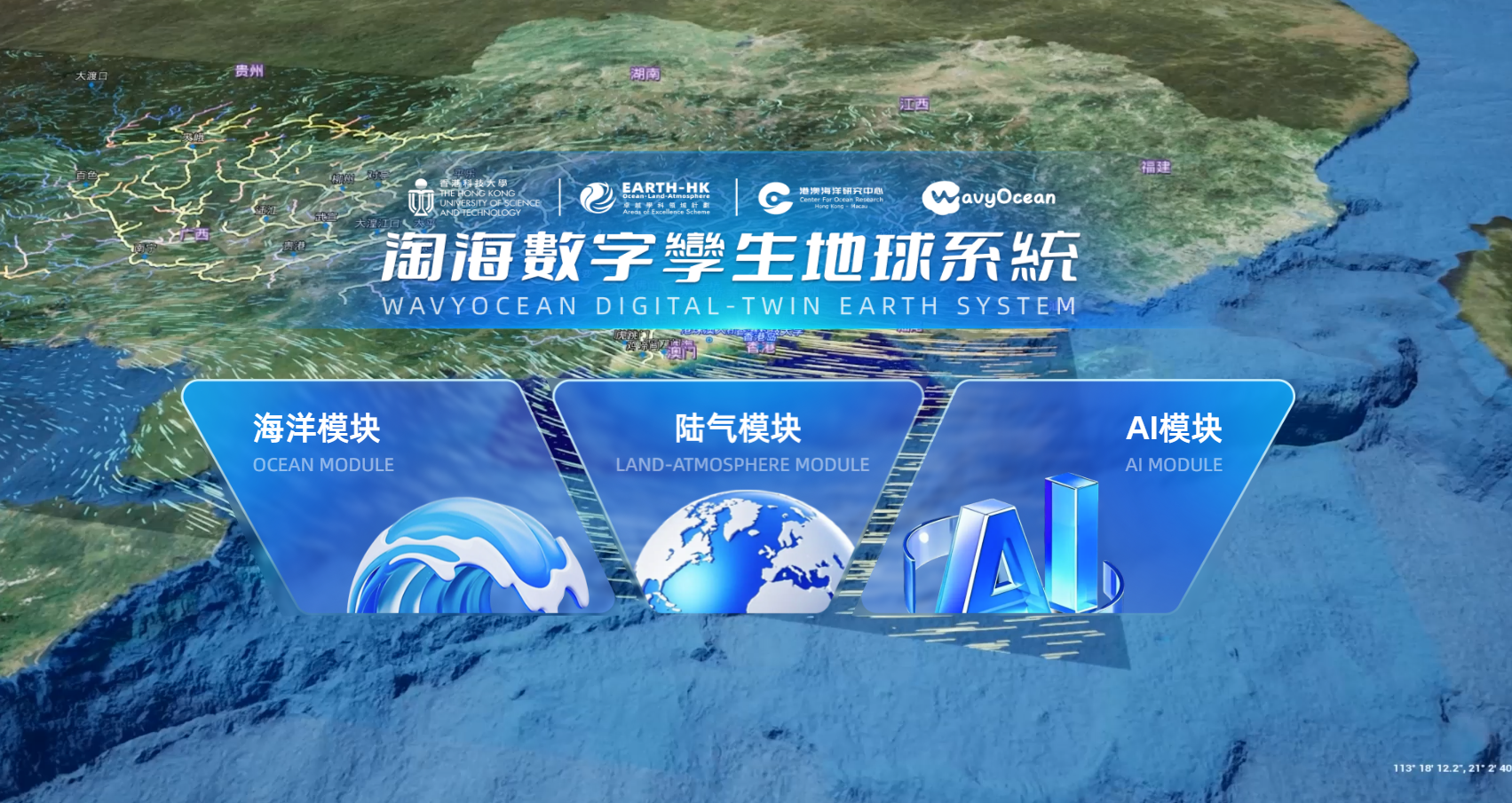
The Hong Kong University of Science and Technology (HKUST) has launched the new WavyOcean Digital Twin Earth System Version 3.0, making its online platform available to the public for the first time. Built around the concept of "Taohai" – a Chinese term meaning "searching or discovering from the sea", the platform transforms ocean data from research-focused resources into shared knowledge accessible to all.
By enhancing the visibility and interpretability of marine ecosystems, the platform promotes deeper public understanding of the ocean and encourages informed actions to support marine conservation and safeguard valuable marine ecosystems.
The newly launched platform represents a comprehensive upgrade of previous versions developed by Prof. GAN Jianping, Chair Professor and Head of the Department of Ocean Science at HKUST, and his research team. Inspired by the concept of "Taobao", the platform allows users to search, filter, combine and visualize ocean data according to their interests and needs—much like they would do on the online shopping platform Taobao. Through this flexible and user-friendly approach, users can create personalized views of complex marine information and explore the ocean in a more intuitive way.
After registering via a web browser, users can enter an immersive and dynamic digital ocean environment to explore a wide range of marine phenomena, from the dispersion of freshwater from the Pearl River Estuary into the South China Sea to variations in the flow of the Kuroshio Current in the western Pacific. Those complex ocean processes, once accessible primarily through specialized scientific models and academic research, are now presented through digital twin technology in a highly visual and interactive format, enabling the public to better understand how the ocean functions and changes over time.
Prof. Gan noted, "The ocean is Earth's largest life-support system, yet it is often overlooked because it is not easily visible. WavyOcean aims to build a bridge through digital twin technology so that everyone has the opportunity to observe it, understand it, and take a more active role in protecting it. From estuaries to the open ocean, from regional ecosystems to basin-scale climate drivers, we hope to open this window wider so that more people can better understand the stories unfolding beneath the ocean’s surface."
Immersive 3D Interactive Experience with Enhanced Rendering and Real-Time Interaction
WavyOcean 3.0 features a comprehensively upgraded 3D rendering engine, significantly enhancing system efficiency, visual quality and interaction responsiveness. Users can freely navigate the platform and explore the ocean’s internal structure from multiple perspectives.
The upgraded immersive mode supports smoother real-time interaction, whether users are examining large-scale ocean circulation systems or detailed regional ocean features. The platform provides seamless visualization and intuitive navigation, creating a more engaging and efficient exploration experience.
Multimodal Data Integration Connecting Atmosphere, Land, and Ocean
WavyOcean 3.0 further expands its geographical coverage to include the Guangdong–Hong Kong–Macao Greater Bay Area (GBA), China's coastal seas (Bohai Sea, Yellow Sea, East China Sea, South China Sea), and key regions of the western Pacific Ocean.
The platform integrates multi-source datasets spanning the atmosphere, land, and ocean, covering physical variables (such as river discharge, precipitation, and ocean currents) and ecological variables (such as chlorophyll, nutrients, and dissolved oxygen). This cross-sphere integration framework enables the systematic visualization of multi-scale physical and ecological processes across the ocean–atmosphere–land system.
Through this comprehensive cross-domain data fusion, WavyOcean constructs a digital twin representation of the regional Earth system. Users can select and combine variables according to their research or application needs, generating customized analytical perspectives and approaches. The "Taohai" mechanism enhances both the accessibility and interpretability of complex marine information, making data exploration more intuitive and efficient.
Diagnostic and Analytical Tools for Flexible Sectioning and Real-Time Analysis
WavyOcean 3.0 incorporates advanced diagnostic and analytical capabilities including flexible cross-sectional slicing tools. Users can generate vertical or horizontal sections at any location and along any direction within the 3D environment to instantly examine the distributions of various ocean variables.
The platform also supports data diagnostics, statistical analysis and graphical visualization, enabling users to move beyond visual observation to quantitative diagnostic analysis. These tools provide valuable technical support for scientific research, education, and policy-making. By selecting variables and analytical approaches tailored to their objectives, users can generate customized ocean data reports and conduct more refined and personalized research, exploration, and application.
Two Versions to Serve Both Public and Professional Communities
A key feature of WavyOcean 3.0 is the simultaneous launch of public and professional editions, designed to address the needs of both general users and specialist communities.
The public version is now open for registration. Users can easily sign up via a web browser through the WavyOcean Digital Twin Earth System or the Taohai platform, with no software installation required, and begin exploring the digital ocean anytime, anywhere.
In addition, the research team has launched a professional edition designed for research institutions, policymakers, and industry partners. The professional edition offers higher-fidelity terrain rendering, a more immersive interactive experience, and advanced visualization and analytical capabilities to support scientific research, policy development, and a wide range of professional applications. Interested organizations and individuals are welcome to contact the team at earthhk@ust.hk for further information on access and licensing arrangements.
About The Hong Kong University of Science and Technology
The Hong Kong University of Science and Technology (HKUST) (https://hkust.edu.hk/) is a world-class university known for its innovative education, research excellence, and impactful knowledge transfer. With a holistic and interdisciplinary pedagogical approach, HKUST was ranked 33rd and 6th in the QS World University Rankings 2027 and QS Asia University Rankings 2026, respectively, and 20th globally in the Times Higher Education Sustainability Impact Ratings 2026, ranking first among universities in Hong Kong and the Chinese Mainland for the third consecutive year. Eleven HKUST subjects were ranked among the world’s top 50 in the QS World University Rankings by Subject 2026. In addition, in the Times Higher Education World University Rankings by Subject 2026, HKUST’s Computer Science discipline which encompasses areas such as artificial intelligence and machine learning, has been ranked No. 1 in Hong Kong for ten consecutive years. Our graduates are highly competitive, consistently ranking among the world’s top 30 most sought-after employees. In terms of research and entrepreneurship, over 80% of our work was rated "internationally excellent" or "world leading" in the Research Assessment Exercise 2020 of the Hong Kong’s University Grants Committee. As of May 2026, HKUST members have founded over 1,900 active start-ups, including 11 Unicorns and 22 exits (IPO or M&A).
For media enquiries, please contact:
PR and Media Team, Global Engagement and Communications Office
Email: media@ust.hk
Sign Up for Our Latest News
Latest News

A research team at The Hong Kong University of Science and Technology (HKUST) has developed a dynamic integrated interface engineering strategy that enhances the energy density and stability of anode-free lithium metal batteries by reconfiguring key battery interfaces. A pouch cell using the strategy achieved a specific energy of 467 Wh kg-1, comparable to conventional commercial batteries. A full coin cell retained 90% of its capacity after 200 cycles.

The Hong Kong University of Science and Technology (HKUST) MBA Program and HKUST Entrepreneurship Center, in collaboration with two leading European student organizations, Erasmus AI Society and MAIN (Maastricht AI & Tech Network), recently concluded the AI Hackathon and Symposium. The event was strongly supported by Hong Kong Talent Engage under the Labour and Welfare Bureau of the HKSAR Government and featured as a flagship event of the Hong Kong AI Summit 2026.

The Hong Kong University of Science and Technology (HKUST) has recently received a generous donation from distinguished alumnus Dr. Joseph CHEUNG Wang Ngai to establish the Dr Joseph W N Cheung Research Excellence Award, a new initiative designed to recognize and support outstanding research achievements at the University. The gift will be designated for HKUST's new School of Medicine and HKUST Business School, underscoring Dr.