




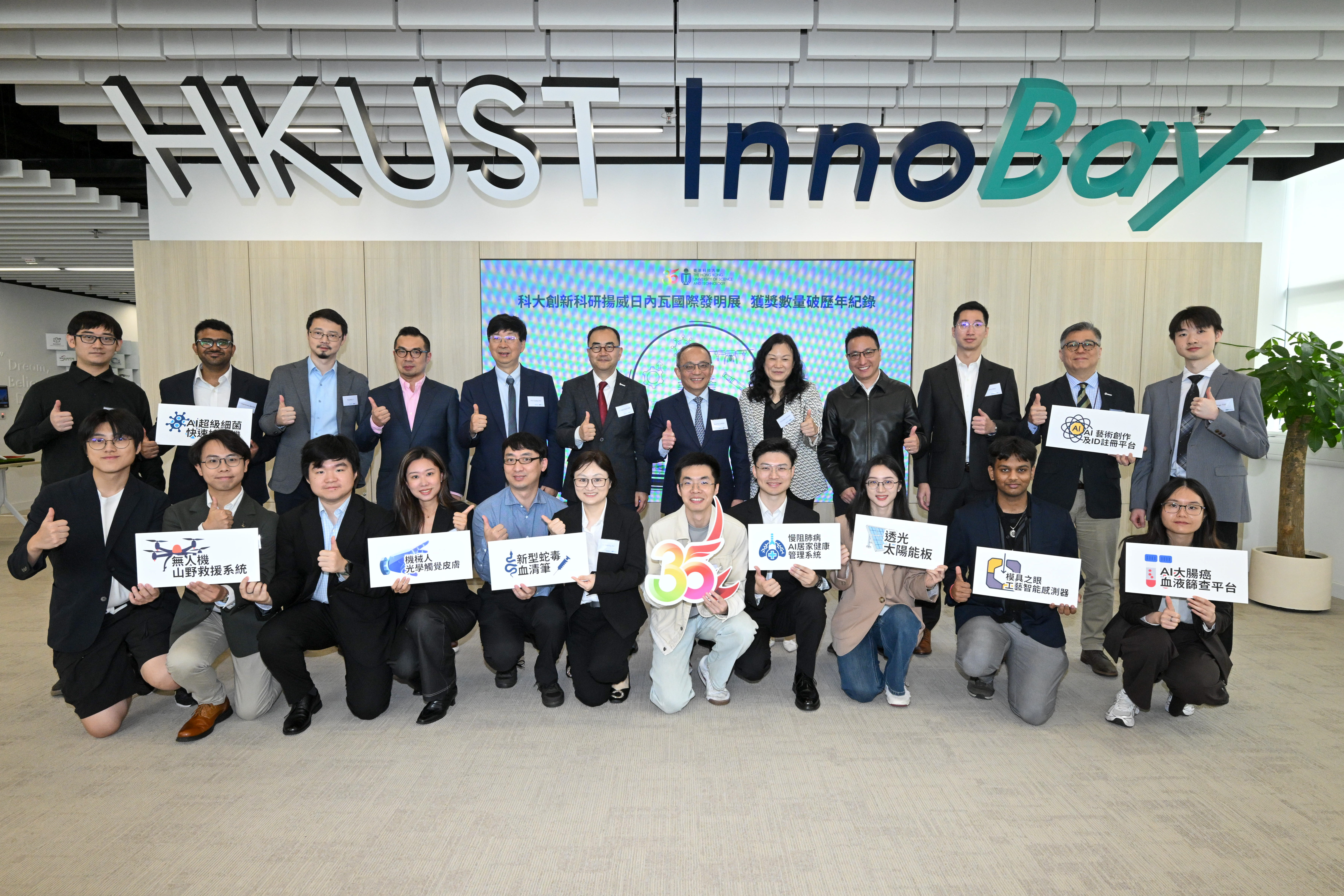
A record-shattering haul of medals at the 51st International Exhibition of Inventions Geneva last month is fueling HKUST's ascent as a powerhouse for global innovation.
The awards – 13 Gold Medals with Congratulations of the Jury, 20 Gold Medals, 20 Silver Medals, and 9 Bronze Medals – constitute one of the strongest indicators yet of the electric synergy between HKUST, HKUST (Guangzhou), and the wider region.
“As Hong Kong deepens its integration into the Guangdong-Hong Kong-Macao Greater Bay Area, the city is perfectly positioned to capitalize on historic opportunities ahead,” said Prof. Tim CHENG, Vice-President for Research and Development at HKUST.
HKUST broke not only its own records at Geneva but also emerged as the highest-awarded higher education institution in Hong Kong this year.
“The HKUST community will continue to illuminate the world with pioneering inventions, translate research outcomes into real-world impact, support Hong Kong's development as an international innovation and technology hub,” added Prof. Cheng.
Prof. Cheng emphasized that HKUST was primed to fully leverage the potential of strategic initiatives such as the Northern Metropolis and the Hetao Shenzhen-Hong Kong Science and Technology Innovation Co-operation Zone in alignment with the nation’s 15th Five-Year Plan.
The ‘X’ Factor
The award-winning inventions from HKUST span various strategic research domains, including AI, electronics, health technologies, the low altitude economy, and materials science.
Notably, over 60% of these projects leverage AI to drive research breakthroughs, further underscoring HKUST's distinctive strengths and robust capabilities in advancing "AI + X" interdisciplinary innovation, i.e., where AI is applied across diverse fields, and real-world applications.
Ultimately, these results demonstrate HKUST’s capacity to transform strategic regional integration into tangible leadership in global innovation.
Invigorating innovations and inventions at HKUST
| 1. AI-powered Home Management for COPD Patients Principal Investigator: Prof. ZHANG Qian | Chronic Obstructive Pulmonary Disease (COPD), encompassing chronic bronchitis and emphysema, often precipitates irreversible pulmonary decline. However, this AI-driven platform brings together three novel technologies: a clinical-grade smart earbud for lung monitoring, a mobile application that decodes cough and respiratory acoustics, and a depth-sensing camera that guides contactless breathing training through real-time visual biofeedback. By decentralizing pulmonary care, the system enables patients to become more proactive in their healthcare. |
| 2. AI-powered Diagnostic Platform for Battling Superbugs Principal Investigator: Prof. Levent YOBAS | Antimicrobial resistance (AMR) looms as one of the top ten global public health threats, escalating patient vulnerability to potentially fatal bacterial infections. To combat this crisis, a groundbreaking AI-driven diagnostic device can detect up to eight pathogens within 45 minutes using just a few drops of blood. This innovation empowers clinicians to rapidly pinpoint an infection source and prescribe the most effective antibiotics. |
3. Fighting Snakebites with Antivenom Cocktails Principal Investigators: Prof. ZHU Guang & Dr. XU Naining | Traditional antivenom production for snakebites is costly. It involves animal immunization and antibody extraction, which can trigger allergic reactions. However, this next-generation recombinant antivenom employs a human monoclonal antibody cocktail that significantly minimizes allergic responses. This lightweight, user-friendly autoinjector allows for immediate on-site administration. This is good news for the thousands of people worldwide whose lives are threatened by snakebites every year, according to the WHO. Although deaths from venomous snakes are rare in Hong Kong, the city’s hospitals see dozens of related admissions throughout the year. |
4. Ultra Early Blood Screening for Cancer
| Colorectal cancer ranks as the second leading cause of cancer death in Hong Kong, with a dismal 9.3% five-year survival rate for late-stage diagnoses. Colonoscopies, though, are highly invasive, while stool and blood-derived tests fall short in detecting precancerous lesions. However, this novel blood screening platform, EpiLumenix, has achieved a remarkable 75% sensitivity for Stage 0 colorectal cancer and advanced adenomas. Such an innovation can genuinely save lives. |
5. UAV First-responder System for remote rescues Principal Investigator: Prof. LI Mo | Ambulances can’t easily reach accident victims on remote hiking trails in Sai Kung or the outlying islands. But this UAV first-responder system, "AeroRelief,” can dramatically cut rescue times. Powered by AI large language models, the system analyzes distress messages to determine the required medical supplies and compute the optimal flight route. The winch-based mid-air delivery system enables precision supplies to be dropped within the critical "golden 10 minutes" needed to protect lives. |
6. Efficient, Durable, Semi-transparent Perovskite Solar Cells
| Traditional solar panels are often unsuitable for windows or glass façades because they are bulky. However, these new semi transparent perovskite solar films with a glass-like appearance enable efficient light harvesting for high power output. These films are ideal for placing on buildings, skylights, and public transport shelters. The material is highly durable and maintains stable electricity output under prolonged sunlight exposure. |
7. Optical Tactile Skin for Next-gen Robotics
| "LightSkin" is an ultra thin (3–5 mm), flexible electronic skin that mimics human tactile sensitivity. It can adapt to complex surfaces on robots, detecting subtle changes in pressure and force to enable safer, more responsive, and intuitive interactions. This innovation opens new possibilities for hand rehabilitation robotics and next generation human–robot collaboration systems. |
8. Quality Control for Zero-Defect Molding Principal Investigator: Prof. GAO Furong | "The Eye of Mold" is a groundbreaking system designed to address long-standing challenges in mold forming processes. Its smart sensors measure three critical parameters—capacitance, temperature, and pressure—enabling, for the first time, real-time visualization of previously inaccessible mold cavity. This innovation provides real-time insights into the flow, filling, and solidification processes, giving manufacturers an unparalleled end-to-end view of the forming process. As a result, it significantly enhances quality control and production stability. |
9. One-stop Platform for Gen-AI Creation and Art ID Registration Principal Investigator: Dr. Daniel CHUN | Artists face growing risks of identity fraud and unauthorized duplication of their work in the AI era. But this one-stop functions as both an Art ID registration platform and a creative studio for artists. It enables artists to manage every aspect of their work, from creation to online sales, all within a single platform. AI is used to assist in the creative process while securely recording artists’ identities and ownership data within a blockchain-enabled database. In addition, secure watermarks store the Art ID and the built in e commerce module facilitates commercialization. |