






News & Stories
2025
News
HKUST Researchers’ Breakthrough Method Reveals Clouds Amplify Global Warming Far More Than Previously Understood
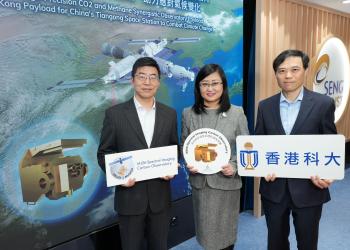
Tropical marine low clouds play a crucial role in regulating Earth’s climate. However, whether they mitigate or exacerbate global warming has long remained a mystery. Now, researchers from the School of Engineering at the Hong Kong University of Science and Technology (HKUST) have developed a groundbreaking method that significantly improves accuracy in climate predictions. This led to a major discovery – that tropical cloud feedback may have amplified the greenhouse effect by a staggering 71% more than previously known to scientists.
The effects of tropical low clouds are difficult to investigate because they are influenced by a variety of factors. Commonly used low cloud controlling factors often struggle to separate the influence of local sea surface temperatures (SSTs) from that of temperatures in the free troposphere – the lowest layer of Earth’s atmosphere, casting uncertainty in projections.
Stories
Beyond the Storm: A Climate Expert’s Vision for Actionable Climate Adaptation Solutions
Landslides, flash floods, and fallen trees—these are just some of the alarming sights accompanying the summer typhoon seasons in Hong Kong. Over the past decade, the city has witnessed a distressing surge in extreme rainfall, characterized by intensity levels that surpass the Black Rainstorm Warning Signal. This trend serves as a stark reminder of the growing impact of global warming on our daily lives and safety. The question resonates: how can we better prepare for nature’s fury in the future?
News
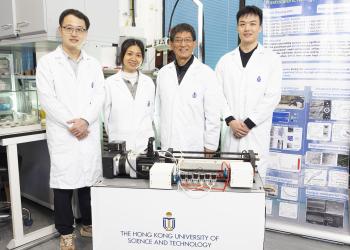
HKUST Develops World’s First Kilowatt-Scale Elastocaloric Green Cooling Device
Researchers at the Hong Kong University of Science and Technology (HKUST) have developed the world’s first kilowatt-scale elastocaloric cooling device. The device can stabilize indoor temperatures at a comfortable 21-22°C in just 15 minutes, even when outdoor temperatures reach between 30-31°C, marking a significant breakthrough toward the commercial application of elastocaloric solid-state cooling technology. The research findings have been published in the leading international science journal Nature, offering a promising solution to combat climate change and accelerate low-carbon transformation of the global cooling industry.
2024
News
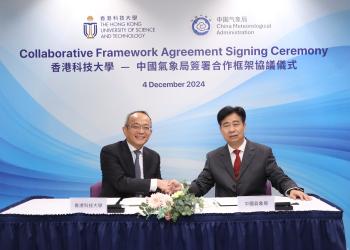
HKUST and CMA Form Strategic Partnership to Advance Meteorological Research and Global Climate Resilience
The Hong Kong University of Science and Technology (HKUST) and the China Meteorological Administration (CMA) have signed a collaborative framework agreement to drive innovation in meteorological science and education. By leveraging the complementary strengths of CMA and HKUST, the collaboration aims to enhance early warning systems, strengthen disaster preparedness, and build climate-resilient communities, underscoring the shared commitment of both institutions to tackle global climate challenges and support the initiatives of the World Meteorological Organization (WMO).
News
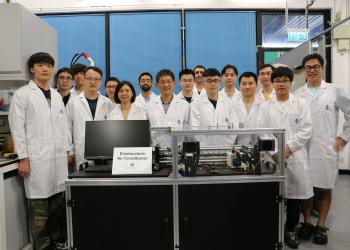
HKUST Engineering Researchers Develop Eco-Friendly Cooling Device with Record-Breaking Efficiency
Researchers at the School of Engineering of the Hong Kong University of Science and Technology (HKUST) have developed an eco-friendly refrigeration device with record-breaking cooling performance in the world, setting to transform industries reliant on cooling and reduce global energy use. With a boost in efficiency of over 48%, the new elastocaloric cooling technology opens a promising avenue for accelerating the commercialization of this disruptive technology and addressing the environmental challenges associated with traditional cooling systems.
News
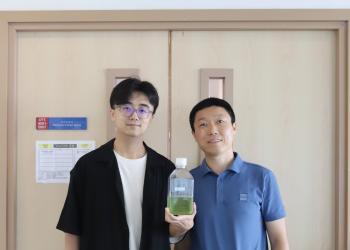
HKUST Researchers Throw New Light on Carboxysomes in Key Discovery that could Boost Photosynthesis
A research team led by the Hong Kong University of Science and Technology (HKUST) has discovered how carboxysomes, carbon-fixing structures found in some bacteria and algae, work. The breakthrough could help scientists redesign and repurpose the structures to enable plants to convert sunlight into more energy, paving the way for improved photosynthesis efficiency, potentially increasing the global food supply and mitigating global warming. Carboxysomes are tiny compartments in certain bacteria and algae that encase particular enzymes in a shell made of proteins. They perform carbon fixation, which is the process of converting carbon dioxide from the atmosphere into organic compounds that can be used by the cell for growth and energy. Scientists have been trying to figure out how these compartments put themselves together.
News
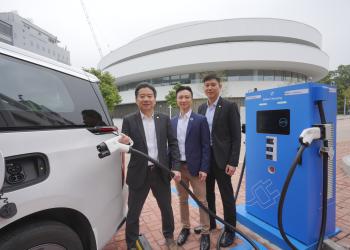
HKUST Enhances Campus EV Charging Infrastructure to Promote Sustainability
The Hong Kong University of Science and Technology (HKUST) is investing up to HK$40 million to upgrade 30% of its total parking space with charging capability and related software support for electric vehicles (EV). The initiative aims to cultivate a sustainable commuting habit and supports emission reduction goals in the HKUST 2028 Sustainability Challenge.HKUST is set to become the most EV-friendly university in Hong Kong with the completion of the EV charging infrastructure enhancement project, which will see approximately 360 parking spaces on campus fitted with medium EV chargers, providing an output power of no less than 7kW. The initiative not only supports the HKSAR Government's Roadmap on Popularization of EVs, but also accelerates opportunities to reduce emissions from University-owned vehicles and indirect emissions from commuting.