



News & Stories
2025
News
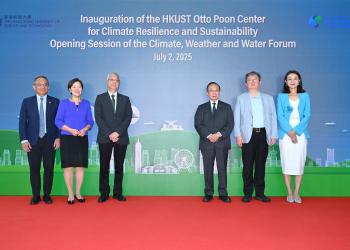
HKUST Unveils Otto Poon Center for Climate Resilience and Sustainability
The Hong Kong University of Science and Technology (HKUST) today inaugurated the Otto Poon Center for Climate Resilience and Sustainability (CCRS), a transformative initiative designed to accelerate research, innovation and policy solutions in climate resilience and sustainable development. Established through the generous support of Ir Dr. Otto POON, Founder of the Otto Poon Charitable Foundation, the Center unites HKUST’s world-class expertise in climate science, advanced modeling systems, artificial intelligence (AI), renewable energy and sustainable policy to deliver scalable and actionable strategies for governments, industries, and communities worldwide.
News
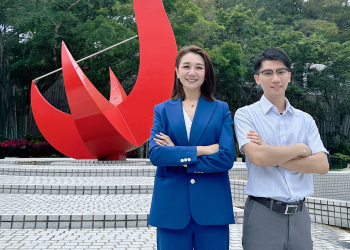
HKUST Study Warns of Accelerating Climate Threat: “Precipitation Whiplashes” Could Strike as Early as 2028
A recent study by The Hong Kong University of Science and Technology (HKUST) reveals a looming climate crisis: the world could face heightened risks of “precipitation whiplashes” – violent swings between extreme droughts and floods – as early as 2028. This research, led by Prof. LU Mengqian and Dr. CHENG Tat-Fan of HKUST’s Department of Civil and Environmental Engineering, attributes the escalating risk to climate-driven intensification of Madden-Julian Oscillation (MJO) events. This large-scale pattern of tropical intraseasonal climate variability is now propagating faster due to global warming.
The findings, published in the prestigious journal Nature Communications, pave the way for improved subseasonal forecasts, i.e., two to six weeks in advance, enabling timely decision-making in disaster preparedness and management, and helping to enhance food and water security, energy management, and infrastructure resilience.
News
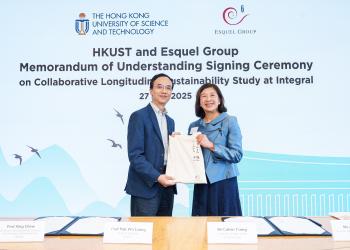
HKUST & Esquel Unveil Five-Year Study: Empowering Students for Sustainable Innovation
The Hong Kong University of Science and Technology (“HKUST”) has partnered with Esquel Enterprises Limited (“Esquel Group”) to launch a five-year study program that allows HKUST students to conduct biannual field research at the textile manufacturer’s 500,000-square-meter Sustainable Development Garden Integral, recognized as one of China’s top 20 sustainable development projects by the United Nations.
Guided by HKUST faculty, students will visit the garden twice a year in groups to assess and make recommendations regarding its sustainability impact on environmental monitoring and biodiversity conservation. This initiative marks another academic-industry collaboration aimed at accelerating the Greater Bay Area’s transition to a low-carbon economy.
News
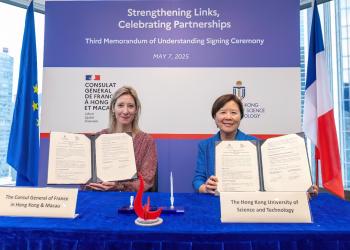
HKUST and French Consulate General Renew Partnership to Nurture Sustainability-Focused Researchers
The Hong Kong University of Science and Technology (HKUST) has renewed its Memorandum of Understanding (MoU) with the Consulate General of France in Hong Kong and Macau (French Consulate General) for the third time, deepening eight-year collaboration. This agreement strengthens joint efforts to address global sustainability challenges, which include the Anita Conti Sustainable Innovation Fellowship, an initiative designed to foster the development of the next generation of researchers, innovators, and environmentalists, equipping them to tackle the pressing challenges of climate change and its global impacts.
News
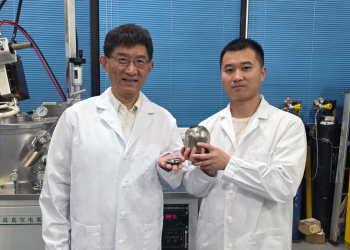
HKUST Discovers Novel Elastic Alloy Achieving 20x Temperature Change and 90% Carnot Efficiency in Solid-State Heat Pumping
Researchers at the School of Engineering of the Hong Kong University of Science and Technology (HKUST) have developed a novel elastic alloy called Ti₇₈Nb₂₂, which achieves remarkable efficiency for solid-state heat pumping and exhibits a reversible temperature change (ΔT) ability that is 20 times greater than that of conventional metals when stretched or compressed, offering a promising green alternative to traditional vapor-compression heating and cooling technologies.
News
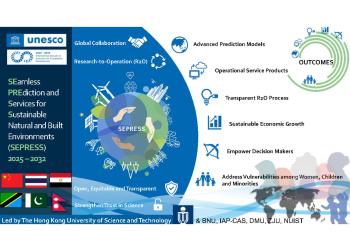
Pioneering Climate Resilience and Sustainability: HKUST Launches Landmark UNESCO-Backed Initiative
The global transdisciplinary "research-to-operation" (R2O) initiative, “Seamless Prediction and Services for Sustainable Natural and Built Environments” (SEPRESS), led by The Hong Kong University of Science and Technology (HKUST), has been endorsed by the United Nations Educational, Scientific and Cultural Organization (UNESCO) as part of its International Decade of Sciences for Sustainable Development (IDSSD). Over the next decade, HKUST’s SEPRESS will spearhead efforts to collaborate with global partners in transforming scientific advancements into tailored solutions that enhance climate resilience and sustainability worldwide, with a particular focus on Least Developed Countries. SEPRESS will achieve this by translating progress in weather-to-climate prediction research into scalable solutions and fostering global partnerships to deliver actionable outcomes.
News
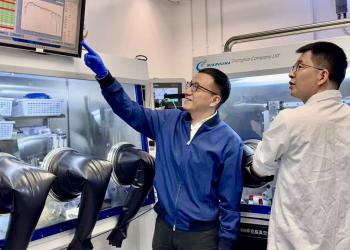
Inspired by Laminate: HKUST and PolyU Researchers Synthesize a Laminate-Structured Material Interface to Improve Perovskite Solar Cells
A collaborative research team from the Hong Kong University of Science and Technology (HKUST) and the Hong Kong Polytechnic University (PolyU) has developed an innovative laminated interface microstructure that enhances the stability and photoelectric conversion efficiency of inverted perovskite solar cells.
News
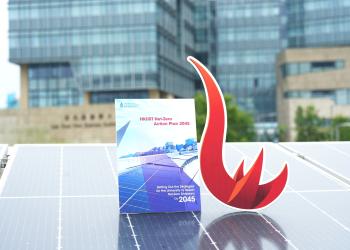
The Race to Zero: HKUST Unveils First Comprehensive Net-Zero Action Plan Among Local Universities
The Hong Kong University of Science and Technology (HKUST) today announces its Net-Zero Action Plan (Action Plan), which is the first among higher education institutions in Hong Kong to have a comprehensive framework with multi-pronged strategies aimed at achieving net-zero emissions by 2045. This plan is supported by a commitment of HK$30 million earned from renewable energy generation to further accelerate research and adoption of innovative decarbonization solutions on campus.