




News & Stories
2025
News
HKUST Researchers Introduce World’s First High-Resolution Global Groundwater Sulfate Distribution Map Uncovering Public Health Risks
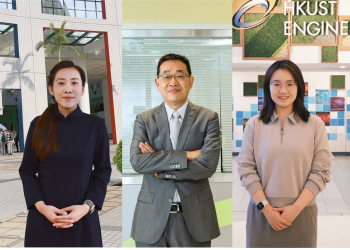
A recent study by the Hong Kong University of Science and Technology (HKUST) has revealed a startling public health threat: About 17 million people are at risk of gastrointestinal problems due to excessive sulfate levels in groundwater. This alarming finding emerged from the world’s first high-resolution global groundwater sulfate distribution map, launched by the university’s School of Engineering.
News
HKUST Researcher Unveiling the Uncharted Reaction Pathways of Carbon Dioxide in Supercritical Water
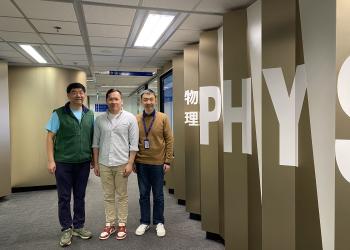
A research team led by Associate Professor Ding PAN from the Department of Physics and the Department of Chemistry at the Hong Kong University of Science and Technology (HKUST), in collaboration with Prof. Yuan Yao from the Department of Mathematics, has made significant discoveries regarding the complex reaction mechanisms of carbon dioxide (CO₂) in supercritical water. These findings are crucial for understanding the molecular mechanisms of CO₂ mineralization and sequestration in nature and engineering, as well as the deep carbon cycle within the Earth's interior.
News
HKUST Develops World’s Smallest Multifunctional Biomedical Robot for Interventional Diagnosis and Treatment
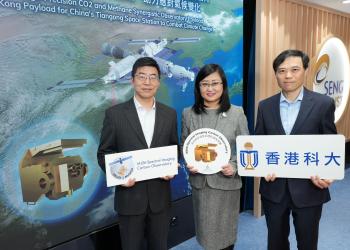
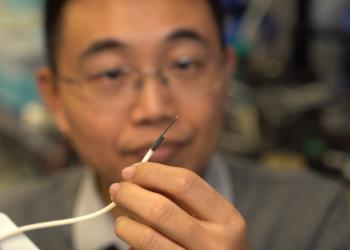
Researchers from the School of Engineering of the Hong Kong University of Science and Technology (HKUST) have successfully developed the world’s smallest multifunctional biomedical robot, which is 60% smaller than current models. Capable of imaging, high-precision motion, and multifunctional operations like sampling, drug delivery, and laser ablation, the robot offers competitive imaging performance and a tenfold improvement in obstacle detection, paving the way for robotic applications in narrow and challenging channels of the human body, such as the lung’s end bronchi and the oviducts.
News
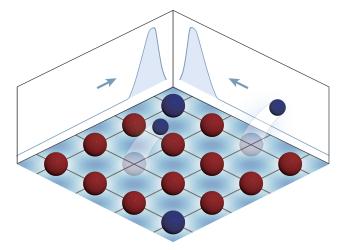
HKUST-led Research Pioneers Simulation of Non-Hermitian Skin Effect in 2D with Ultracold Fermions
A research team led by The Hong Kong University of Science and Technology (HKUST) has achieved a groundbreaking quantum simulation of the non-Hermitian skin effect in two dimensions using ultracold fermions, marking a significant advance in quantum physics research.Quantum mechanics, which typically considers a well-isolated system from its environment, describes ubiquitous phenomena ranging from electron behavior in solids to information processing in quantum devices. This description typically requires a real-valued observable—specifically, a Hermitian model (Hamiltonian).
2024
News
HKUST Engineering Researchers Develop World’s First Deep-UV MicroLED Display Chips for Maskless Photolithography
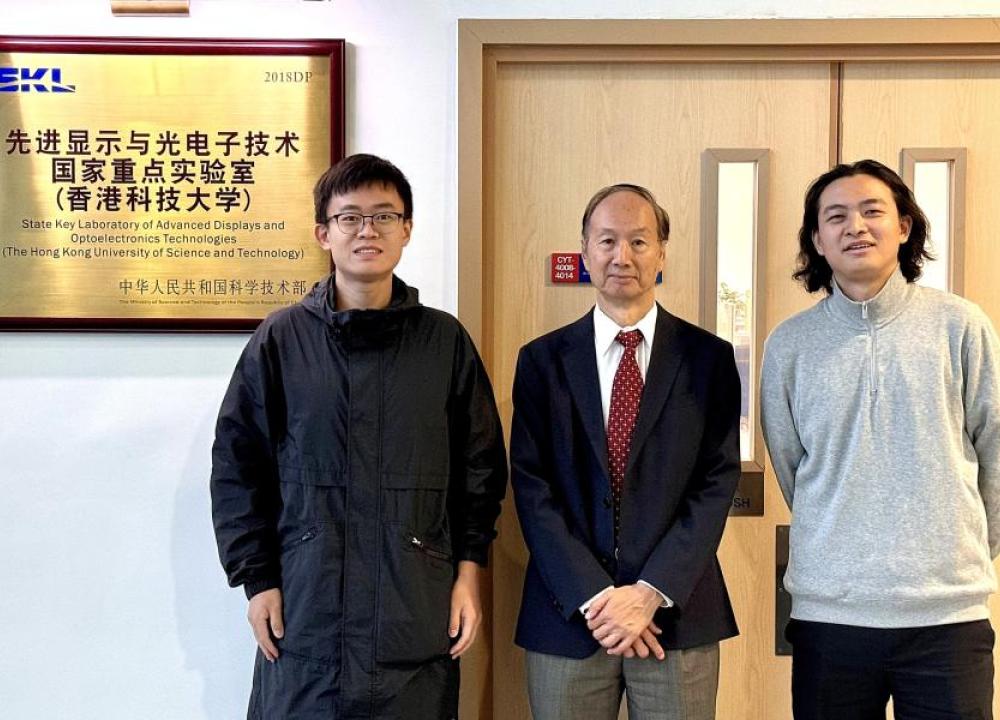
In a breakthrough set to revolutionize the semiconductor industry, the School of Engineering of the Hong Kong University of Science and Technology (HKUST) has developed the world’s first-of-its-kind deep-ultraviolet (UVC) microLED display array for lithography machines. This enhanced efficiency UVC microLED has showcased the viability of a lowered cost maskless photolithography through the provision of adequate light output power density, enabling exposure of photoresist films in a shorter time. Conducted under the supervision of Prof. KWOK Hoi-Sing, Founding Director of the State Key Laboratory of Advanced Displays and Optoelectronics Technologies at HKUST, the study was a collaborative effort with the Southern University of Science and Technology, and the Suzhou Institute of Nanotechnology of the Chinese Academy of Sciences.
News
HKUST Researchers Introduce Thermal-Electric Aerosol Printer to Make Piezoelectric Biofilms at Unprecedented Speed
A study led by the School of Engineering of the Hong Kong University of Science and Technology (HKUST) has developed a groundbreaking thermal-electric aerosol (TEA) printer that significantly accelerates piezoelectric biofilm manufacturing. Achieving a speed that is two orders of magnitude faster than existing technologies, this innovation paves the way for the industrial-scale production of biocompatible and biodegradable electronics, with medical applications such as ultrasonic energy harvesters for postoperative cardiac patients.
News
HKUST Unveils AI Anchor to Present University Achievements (Chinese Version Only)
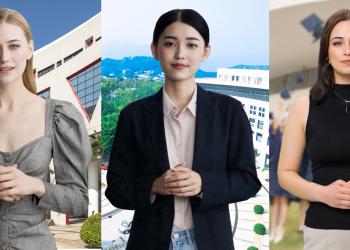
隨著AI技術發展一日千里,香港科技大學(科大)繼早前首創亞洲第一批「AI講師」後,再創新猷「聘請」獲學生票選為「最受歡迎AI講師」的Fiona出任科大首位AI主播,肩負報導大學發展、科研成就及重大活動的重任。
這位「AI主播」已於校園電視上亮相,為師生提供一種新穎的方式來了解大學的最新資訊,其他講師亦已陸續加盟主播行列,務求為師生締造新鮮感,並體驗AI科技的威力。
此項計劃由科大環球事務及傳訊處牽頭推動,自AI講師面世以來,團隊便與科大(廣州)計算媒體與藝術學域講座教授及科大新興跨領域講座教授許彬及其學生展開合作,了解「AI講師」的技術及學生反饋,並探索「招攬」他們出任校園主播的可行性。