



News & Stories
2019
News
Real Learning Stems not Just from Funding
By Prof. Mansun Chan, Chair Professor of Electronic and Computer Engineering, HKUST
As the modern-day workplace evolves, it is clear that science, technology, engineering and mathematics will play increasingly larger roles, prompting the government to provide incentives to increase STEM education at schools.
A one-off grant of HK$100,000 was provided to each primary school to support STEM education and activities in 2016, and HK$200,000 to each secondary school in 2017.
In his latest budget, Financial Secretary Paul Chan Mo-po allocated HK$500 million to implement an IT Innovation Lab program in the next three school years; each subsidized secondary school will be granted HK$1 million to help students build an IT foundation.
2009
News
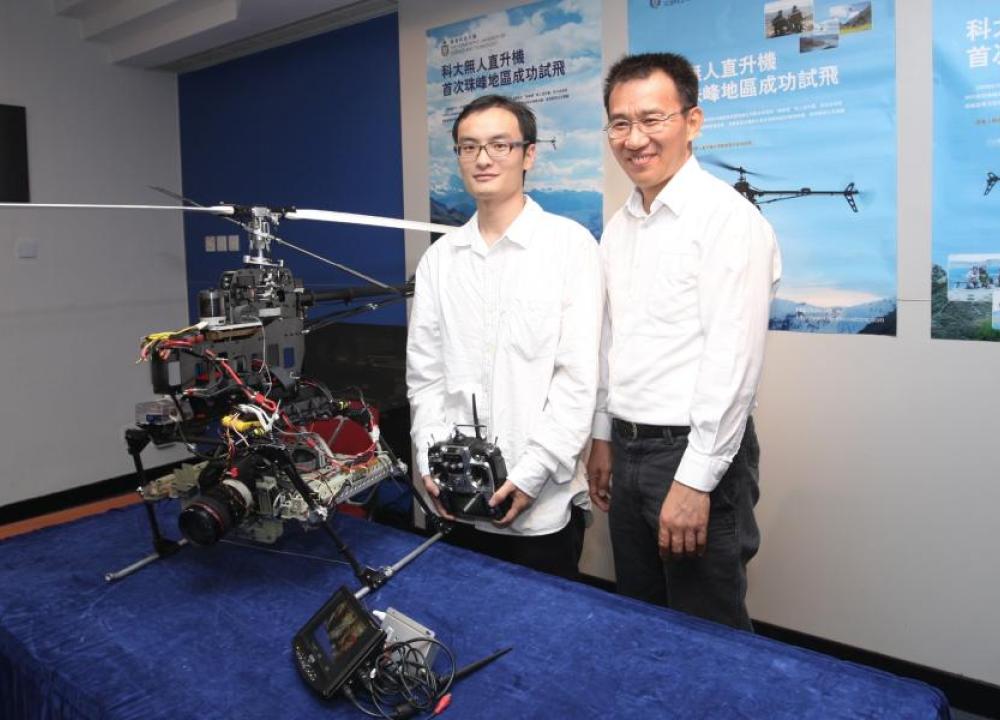
HKUST Unmanned Helicopter Makes World's First Autonomous Flight to Mount Everest
An unmanned miniature helicopter developed by The Hong Kong University of Science and Technology (HKUST) has made the world's first autonomous flight to Mount Everest, setting a milestone both in the history of unmanned aviation and in the surveying and protection of high altitude environments.This was part of a series of test flights carried out over a 10-day period in mid June this year by Prof Zexiang Li of HKUST's Electronic and Computer Engineering Department, assisted by his postgraduate student Mr Frank Wang.The flights covered various spots in the Tibetan Highland, including Mount Everest, lakes, a glacier, and a maiden forest."The biggest challenge of these test flights is the extreme climatic conditions in the high altitudes, particularly the thin air and the exceptionally strong and gusty winds," said Prof Li.