



News & Stories
2014
News
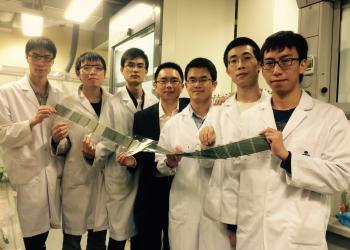
HKUST develops materials for record efficiency polymer solar cells
A research team at the Hong Kong University of Science and Technology (HKUST) has developed a family of polymer and fullerene materials that enabled multiple cases of high-efficiency polymer solar cells. The team, led by Prof He Yan of the Department of Chemistry, discovered a material design motif that led to three new polymers and over ten high-performance material combinations yielding solar cell efficiencies of up to 10.8%, a new record for single-junction polymer solar cells.
News
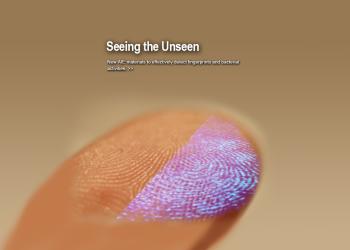
Seeing the Unseen
A HKUST research team led by Prof Benzhong Tang,Stephen Kam-chuen Cheong Professor of Science, Chair Professor of Chemistry at HKUST, has discovered new aggregation-induced emission (AIE) materials which could be used for applications in forensic science and bacterial imaging.
The new AIE materials produce fingerprints of much better quality as compared to carbon powder, saving 90 per cent of the time in evidence collection. They also make a more accurate and stable agent in detecting bacterial activities.
Prof Benzhong Tang said AIE gives fingerprints of much better quality and more efficiently than the carbon powder which is now being used by police.
AIE does not involve a transfer. Police can simply take a picture of a fingerprint, which turns fluorescent when stained with the AIE material, then send the image to a smart device for comparison on a database.
News
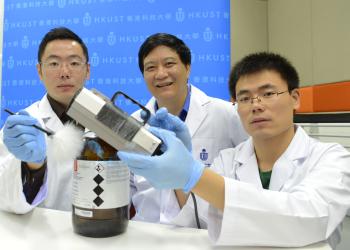
HKUST Discovers New Aggregation-Induced Emission (AIE) Materials for Applications in Forensic Science and Bacterial Imaging
A Hong Kong University of Science and Technology research team led by Prof Benzhong Tang - Stephen Kam-chuen Cheong Professor of Science, Chair Professor of Chemistry and a member of the Chinese Academy of Sciences, has discovered new AIE materials which could be used on visualizing fingerprints and revealing bacteria with greater effectiveness. The new materials not only produce fingerprints of much better quality as compared to carbon powder, saving 90 per cent of the time in evidence collection, they also make a more accurate and stable agent in detecting bacterial activities.
Prof Tang has developed numerous AIE materials ever since his discovery of the AIE phenomenon in 2001, they were applied in a wide range of areas including high-performance OLEDs, cancer screening and environmental monitoring. His latest discoveries have expanded AIE’s applications into the arena of forensic science and bacterial detection.
News
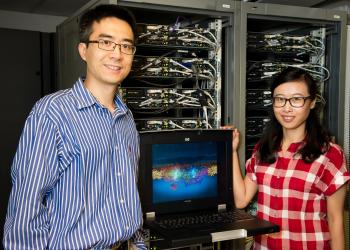
HKUST Chemists Unveil Mechanisms of Photosynthesis for Promising Renewable Energy Development
A research team at the Hong Kong University of Science and Technology (HKUST) has solved a long-standing question in photosynthesis which provides insight into the design of artificial photosynthetic systems that may serve as alternative energy devices by effectively utilizing the sunlight. The research was led by Assistant Prof Xuhui Huang and Prof Yijing Yan of the Department of Chemistry and their findings were recently published in the prestigious journal Nature Communications.
2021
News
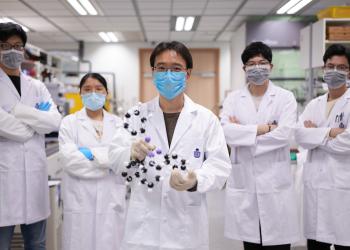
HKUST Researchers Find Novel Way to Produce New Kind of Chiral Molecules Bringing New Hope for Drug Development
A research team from the Hong Kong University of Science and Technology (HKUST) has discovered a method that would allow the production of a new type of spherical molecules not easily obtainable before. Preliminary testing has also shown that such molecules – chiral tetraarylmethanes (CTAMs), display good deterrent effects against cancer cells such as those of cervical, lung, breast and colorectal, as well as the virus causing the Hand, Foot and Mouth disease (HFMD) and a type of coronavirus.